Call
 Enquire
 Search



Menu

Manage my booking

| Sales | |
| Monday - Friday | 09:00 - 19:00 |
| Saturday | 09:00 - 16:00 |
| Sunday | 10:00 - 17:00 |
| Bank Holiday | 10:00 - 16:00 |
| Aftersales | |
| Monday - Friday | 09:00 - 17:30 |
| Bank Holiday | 10:00 - 16:00 |



16 Oct - 25 Oct 2027

9 Nights onboard Seven Seas Prestige

All Inclusive Drinks*

Water bottle*

Butler*

Room Service*

Soft drinks*

Speciality Dining*

Gratuities*

Shore Excursions*

Entertainment*

Wi-Fi*
Not Available
Not Available
Not Available
from
£8,229
per person
Our experts are here to help
Call us today on 0203 930 4640 or enquire online.





 Up to 45% Off Select 2026 & 2027 Sailings*A Low 7.5% Deposit on Select Sailings*Single Supplement Special*
*Select voyages. T's and C's apply
Day 1
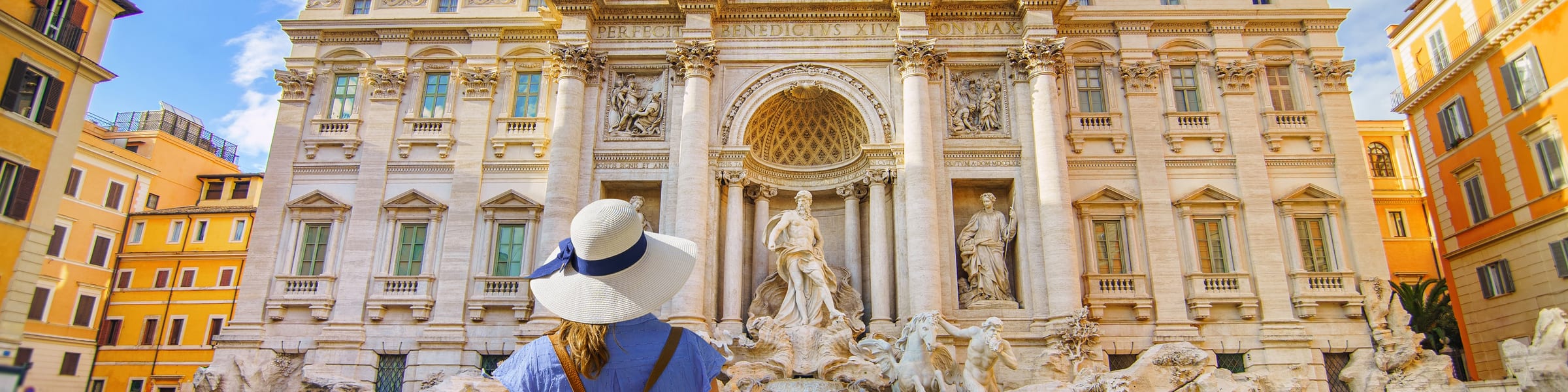
Italy's vibrant capital lives in the present, but no other city on earth evokes its past so powerfully. For over 2,500 years, emperors, popes, artists, and common citizens have left their mark here. Archaeological remains from ancient Rome, art-stuffed churches, and the treasures of Vatican City vie for your attention, but Rome is also a wonderful place to practice the Italian-perfected il dolce far niente, the sweet art of idleness. Your most memorable experiences may include sitting at a caffè in the Campo de' Fiori or strolling in a beguiling piazza.
Day 2
Sorrento may have become a jumping-off point for visitors to Pompeii, Capri, and Amalfi, but you can find countless reasons to love it for itself. The Sorrentine people are fair-minded and hardworking, bubbling with life and warmth. The tuff cliff on which the town rests is spread over the bay, absorbing sunlight, while orange and lemon trees waft their perfume in spring. Winding along a cliff above a small beach and two harbors, the town is split in two by a narrow ravine formed by a former mountain stream. To the east, dozens of hotels line busy Via Correale along the cliff—many have "grand" included in their names, and some indeed still are. To the west, however, is the historic sector, which still enchants. It's a relatively flat area, with winding, stone-paved lanes bordered by balconied buildings, some joined by medieval stone arches. The central piazza is named after the poet Torquato Tasso, born here in 1544. This part of town is a delightful place to walk through. Craftspeople are often at work in their stalls and shops and are happy to let you watch; in fact, that's the point. Music spots and bars cluster in the side streets near Piazza Tasso.
Day 3
Home to the Museo Regionale of Messina, known for featuring two of Caravaggio's paintings, the city is also famous for having been the capital of the ancient kingdom of Sicily.
Day 4
Malta's capital, the minicity of Valletta, has ornate palaces and museums protected by massive fortifications of honey-color limestone. Houses along the narrow streets have overhanging wooden balconies for people-watching from indoors. Generations ago they gave housebound women a window on the world of the street. The main entrance to town is through the City Gate (where all bus routes end), which leads onto Triq Repubblika (Republic Street), the spine of the grid-pattern city and the main shopping street. Triq Mercante (Merchant Street) parallels Repubblika to the east and is also good for strolling. From these two streets, cross streets descend toward the water; some are stepped. Valletta's compactness makes it ideal to explore on foot. City Gate and the upper part of Valletta are experiencing vast redevelopment that includes a new Parliament Building and open-air performance venue. The complex, completed mid-2013, has numerous pedestrian detours in place along with building noise and dust. Before setting out along Republic Street, stop at the tourist information office on Merchant Street for maps and brochures.
Day 5
Day 6
Day 7
Backed by imposing mountains, tiny Kotor lies hidden from the open sea, tucked into the deepest channel of the Bokor Kotorska (Kotor Bay), which is Europe's most southerly fjord. To many, this town is more charming than its sister UNESCO World Heritage Site, Dubrovnik, retaining more authenticity, but with fewer tourists and spared the war damage and subsequent rebuilding which has given Dubrovnik something of a Disney feel.Kotor's medieval Stari Grad (Old Town) is enclosed within well-preserved defensive walls built between the 9th and 18th centuries and is presided over by a proud hilltop fortress. Within the walls, a labyrinth of winding cobbled streets leads through a series of splendid paved piazzas, rimmed by centuries-old stone buildings. The squares are now haunted by strains from buskers but although many now house trendy cafés and chic boutiques, directions are still given medieval-style by reference to the town’s landmark churches.In the Middle Ages, as Serbia's chief port, Kotor was an important economic and cultural center with its own highly regarded schools of stonemasonry and iconography. From 1391 to 1420 it was an independent city-republic and later, it spent periods under Venetian, Austrian, and French rule, though it was undoubtedly the Venetians who left the strongest impression on the city's architecture. Since the breakup of Yugoslavia, some 70% of the stone buildings in the romantic Old Town have been snapped up by foreigners, mostly Brits and Russians. Porto Montenegro, a new marina designed to accommodate some of the world’s largest super yachts, opened in nearby Tivat in 2011, and along the bay are other charming seaside villages, all with better views of the bay than the vista from Kotor itself where the waterside is congested with cruise ships and yachts. Try sleepy Muo or the settlement of Prčanj in one direction around the bay, or Perast and the Roman mosaics of Risan in the other direction.
Day 8
Nothing can prepare you for your first sight of Dubrovnik. Lying 216 km (135 miles) southeast of Split and commanding a jaw-dropping coastal location, it is one of the world's most beautiful fortified cities. Its massive stone ramparts and fortress towers curve around a tiny harbor, enclosing graduated ridges of sun-bleached orange-tiled roofs, copper domes, and elegant bell towers. Your imagination will run wild picturing what it looked like seven centuries ago when the walls were built, without any suburbs or highways around it, just this magnificent stone city rising out of the sea.In the 7th century AD, residents of the Roman city Epidaurum (now Cavtat) fled the Avars and Slavs of the north and founded a new settlement on a small rocky island, which they named Laus, and later Ragusa. On the mainland hillside opposite the island, the Slav settlement called Dubrovnik grew up. In the 12th century the narrow channel separating the two settlements was filled in (now the main street through the Old Town, called Stradun), and Ragusa and Dubrovnik became one. The city was surrounded by defensive walls during the 13th century, and these were reinforced with towers and bastions in the late 15th century.From 1358 to 1808 the city thrived as a powerful and remarkably sophisticated independent republic, reaching its golden age during the 16th century. In 1667 many of its splendid Gothic and Renaissance buildings were destroyed by an earthquake. The defensive walls survived the disaster, and the city was rebuilt in baroque style.Dubrovnik lost its independence to Napoléon in 1808, and in 1815 passed to Austria-Hungary. During the 20th century, as part of Yugoslavia, the city became a popular tourist destination, and in 1979 it was listed as a UNESCO World Heritage Site. During the war for independence, it came under heavy siege. Thanks to careful restoration, few traces of damage remain; however, there are maps inside the Pile and Ploče Gates illustrating the points around the city where damage was done. It’s only when you experience Dubrovnik yourself that you can understand what a treasure the world nearly lost
Day 9
Dalmatia's capital for more than 1,000 years, Zadar is all too often passed over by travelers on their way to Split or Dubrovnik. What they miss out on is a city of more than 73,000 that is remarkably lovely and lively despite—and, in some measure, because of—its tumultuous history. The Old Town, separated from the rest of the city on a peninsula some 4 km (2½ miles) long and just 1,640 feet wide, is bustling and beautiful: the marble pedestrian streets are replete with Roman ruins, medieval churches, palaces, museums, archives, and libraries. Parts of the new town are comparatively dreary, a testament to what a world war followed by decades of communism, not to mention a civil war, can do to the architecture of a city that is 3,000 years old. A settlement had already existed on the site of the present-day city for some 2,000 years when Rome finally conquered Zadar in the 1st century BC; the foundations of the forum can be seen today. Before the Romans came the Liburnians had made it a key center for trade with the Greeks and Romans for 800 years. In the 3rd century BC the Romans began to seriously pester the Liburnians, but required two centuries to bring the area under their control. During the Byzantine era, Zadar became the capital of Dalmatia, and this period saw the construction of its most famous church, the 9th-century St. Donat's Basilica. It remained the region's foremost city through the ensuing centuries. The city then experienced successive onslaughts and occupations—both long and short—by the Osogoths, the Croatian-Hungarian kings, the Venetians, the Turks, the Habsburgs, the French, the Habsburgs again, and finally the Italians before becoming part of Yugoslavia and, in 1991, the independent republic of Croatia. Zadar was for centuries an Italian-speaking city, and Italian is still spoken widely, especially by older people. Indeed, it was ceded to Italy in 1921 under the Treaty of Rapallo (and reverted to its Italian name of Zara). Its occupation by the Germans from 1943 led to intense bombing by the Allies during World War II, which left most of the city in ruins. Zadar became part of Tito's Yugoslavia in 1947, prompting many Italian residents to leave. Zadar's most recent ravages occurred during a three-month siege by Serb forces and months more of bombardment during the Croatian-Serbian war between 1991 and 1995. But you'd be hard-pressed to find outward signs of this today in what is a city to behold. There are helpful interpretive signs in English all around the Old Town, so you certainly won't feel lost when trying to make sense of the wide variety of architectural sites you might otherwise pass by with only a cursory look.
Day 10
Up until the end of World War I, Trieste was the only port of the vast Austro-Hungarian Empire and therefore a major industrial and financial center. In the early years of the 20th century, Trieste and its surroundings also became famous by their association with some of the most important names of Italian literature, such as Italo Svevo, and English and German letters. James Joyce drew inspiration from the city's multiethnic population, and Rainer Maria Rilke was inspired by the seacoast west of the city. Although it has lost its importance as a port and a center of finance, it has never fully lost its roll as an intellectual center. The streets hold a mix of monumental, neoclassical, and art-nouveau architecture built by the Austrians during Trieste's days of glory, granting an air of melancholy stateliness to a city that lives as much in the past as the present.

from £8,229 per person
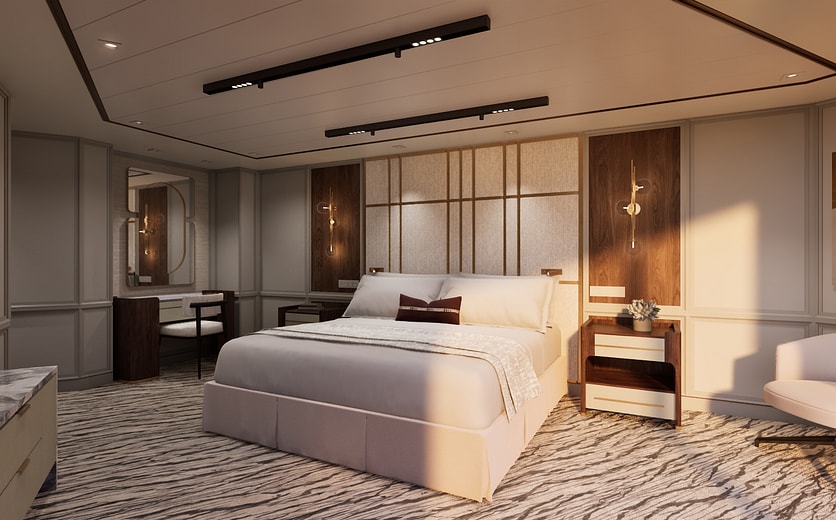
Ship renderings are artistic representations intended to provide a vision of the ship experience. Actual layouts, furnishings, and design elements may vary by deck, and specific location.
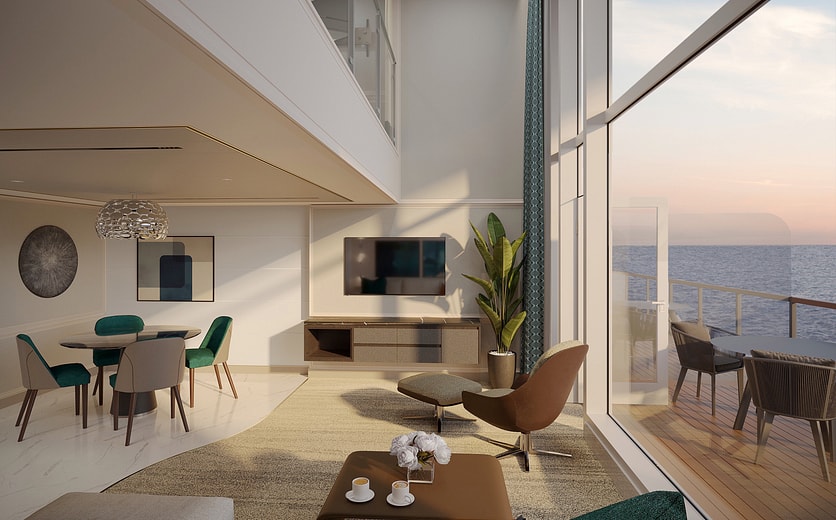
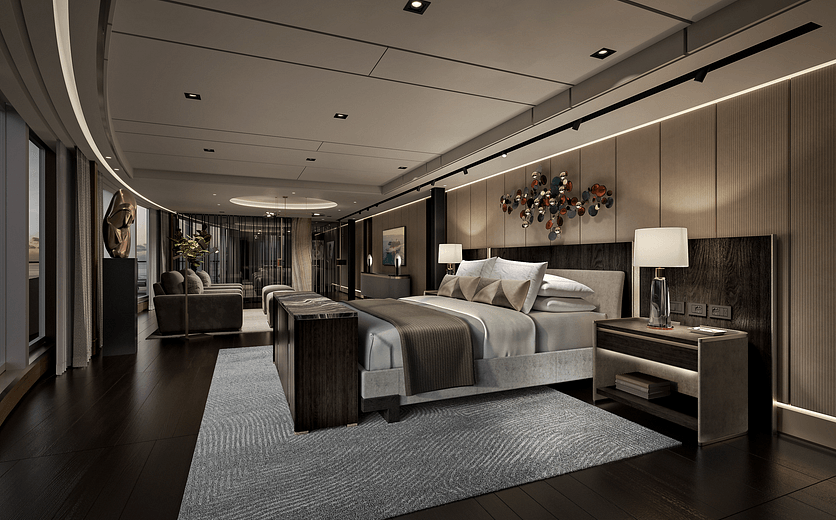
With their contemporary, sophisticated design, 4 double-story, 856 sq. ft. Grand Loft Suites evoke the feel of a refined Lower Manhattan residence. A dramatic double-height space and extraordinary window wall create jaw-dropping views from the upstairs loft bedroom, which faces directly toward the horizon. A neutral palette, tone-on-tone subtlety, and clean, tailored lines lend the suite a timeless yet modern character, with materials, fixtures, and fabrics carefully selected for their richness, comfort, and understated elegance.
Ship renderings are artistic representations intended to provide a vision of the ship experience. Actual layouts, furnishings, and design elements may vary by deck, and specific location.
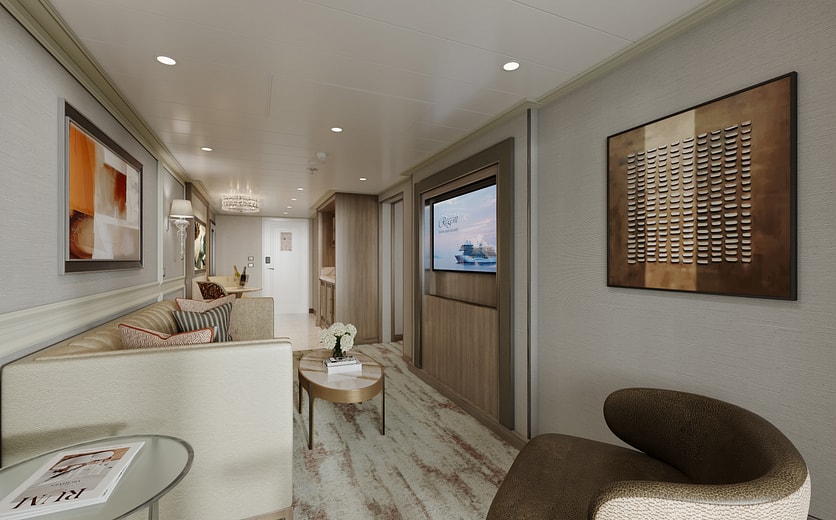
The Horizon Penthouse Suites on Seven Seas Prestige™ feature a beautifully appointed bedroom, a full bath suite, and a spacious living area. A standout feature in some of these suites is the oversized balcony—measuring up to 263 sq. ft.—which is part of the suite’s total size ranging from 600 sq. ft. to 726 sq. ft. This expansive outdoor space includes a dining area, plush sofa, and sun loungers, offering a perfect setting for open-air relaxation. With just 15 suites in this category, guests enjoy an exclusive experience that seamlessly blends indoor comfort with outdoor luxury.
Ship renderings are artistic representations intended to provide a vision of the ship experience. Actual layouts, furnishings, and design elements may vary by deck, and specific location.
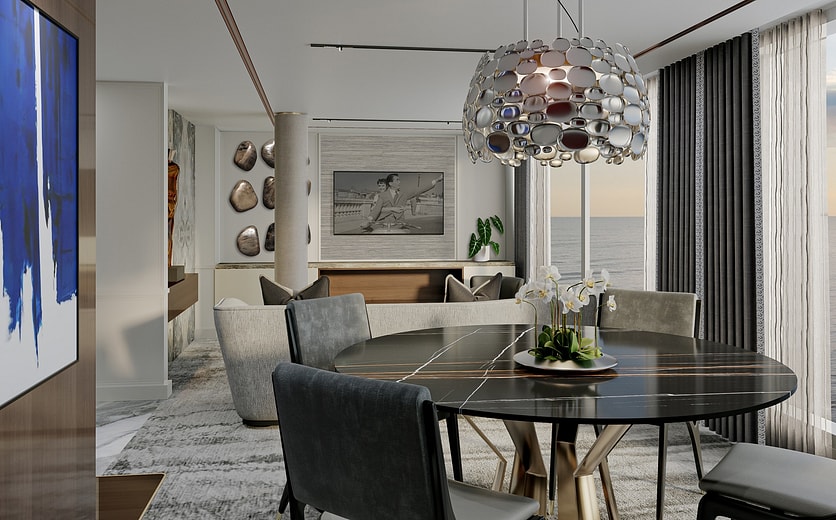
Offering a total of 2,037 sq. ft. the Signature Suites are outfitted with a rich color palette and the finest fabrics across two spacious bedrooms and two bathrooms, along with a generous living room. A private wraparound balcony — one of the largest at sea at 1,023 sq. ft. — extends the living space outdoors, making it ideal for entertaining or simply soaking in the view.
Ship renderings are artistic representations intended to provide a vision of the ship experience. Actual layouts, furnishings, and design elements may vary by deck, and specific location.
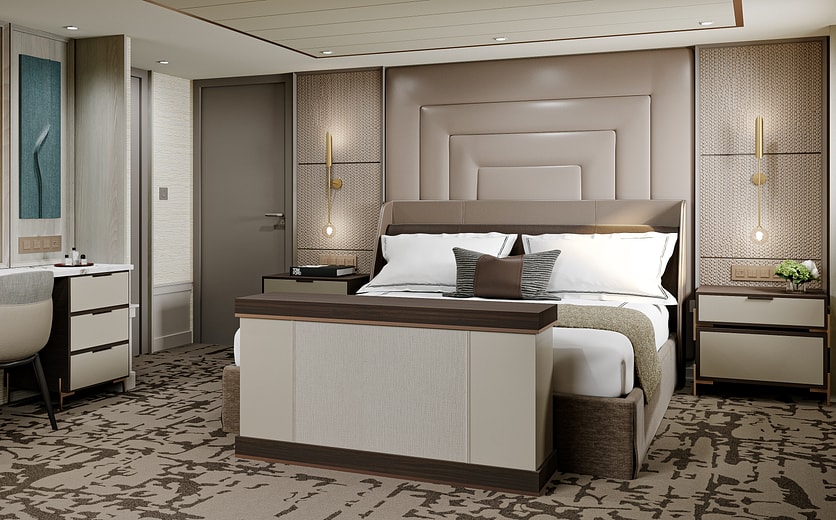
The Grand Suites feature clean lines, mid-century inspired furniture and a color palette that features neutrals with shades of green. The design highlights Italian artistry with textured fabrics and woven leather accents, creating a sophisticated and luxurious ambiance. At 1,214-1,417 sq. ft., the suite houses a private terrace as well as a dining room for in-suite meals.
Ship renderings are artistic representations intended to provide a vision of the ship experience. Actual layouts, furnishings, and design elements may vary by deck, and specific location.
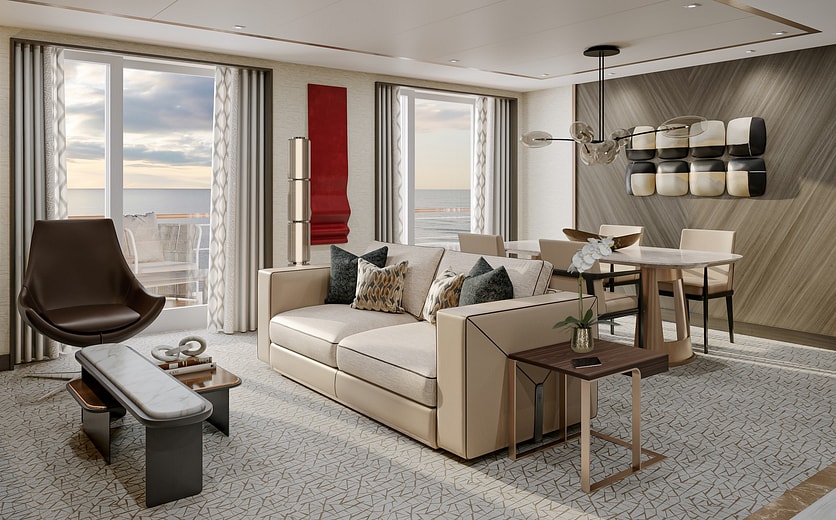
At 813-1,354 sq. ft., the thoughtfully designed Prestige Suites are the embodiment of refined living at sea. The one-bedroom, one-and-a-half bathroom suites are designed with calming hues of cream, gray and brown. They feature a dining table for in-suite service, a spacious closet and an elegant bath.
Ship renderings are artistic representations intended to provide a vision of the ship experience. Actual layouts, furnishings, and design elements may vary by deck, and specific location.
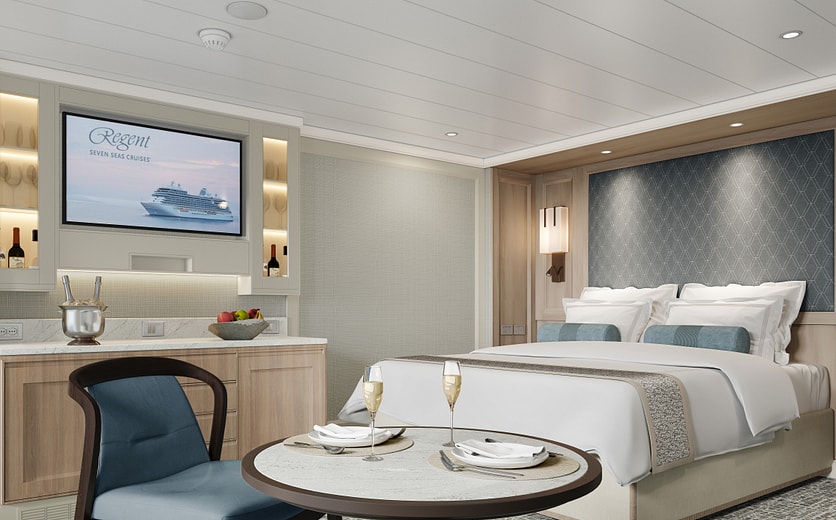
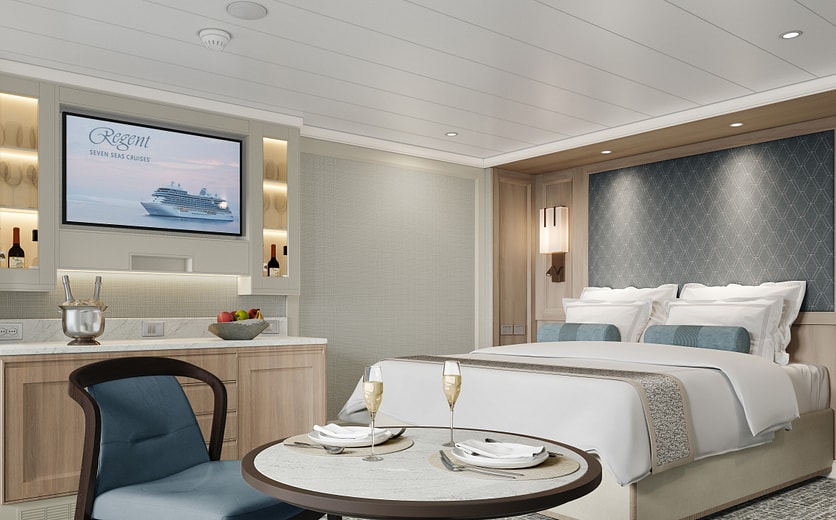
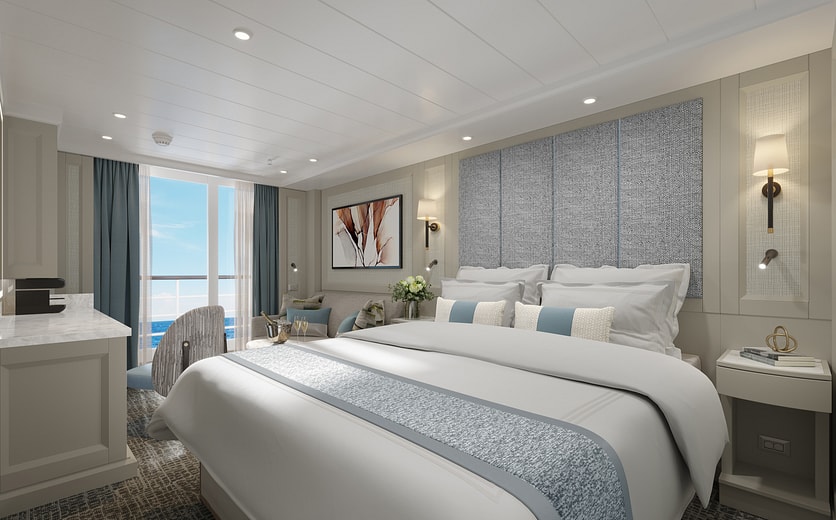
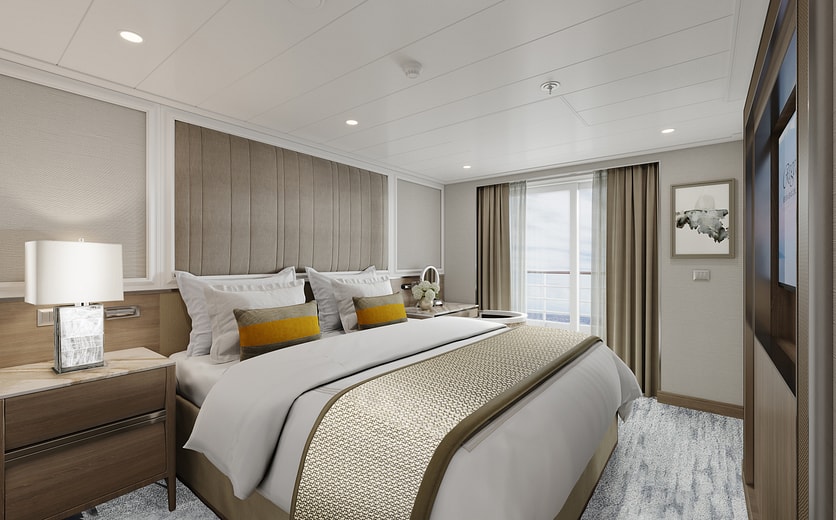
from £8,229 per person
Ship renderings are artistic representations intended to provide a vision of the ship experience. Actual layouts, furnishings, and design elements may vary by deck, and specific location.
With their contemporary, sophisticated design, 4 double-story, 856 sq. ft. Grand Loft Suites evoke the feel of a refined Lower Manhattan residence. A dramatic double-height space and extraordinary window wall create jaw-dropping views from the upstairs loft bedroom, which faces directly toward the horizon. A neutral palette, tone-on-tone subtlety, and clean, tailored lines lend the suite a timeless yet modern character, with materials, fixtures, and fabrics carefully selected for their richness, comfort, and understated elegance.
Ship renderings are artistic representations intended to provide a vision of the ship experience. Actual layouts, furnishings, and design elements may vary by deck, and specific location.
The Horizon Penthouse Suites on Seven Seas Prestige™ feature a beautifully appointed bedroom, a full bath suite, and a spacious living area. A standout feature in some of these suites is the oversized balcony—measuring up to 263 sq. ft.—which is part of the suite’s total size ranging from 600 sq. ft. to 726 sq. ft. This expansive outdoor space includes a dining area, plush sofa, and sun loungers, offering a perfect setting for open-air relaxation. With just 15 suites in this category, guests enjoy an exclusive experience that seamlessly blends indoor comfort with outdoor luxury.
Ship renderings are artistic representations intended to provide a vision of the ship experience. Actual layouts, furnishings, and design elements may vary by deck, and specific location.
Offering a total of 2,037 sq. ft. the Signature Suites are outfitted with a rich color palette and the finest fabrics across two spacious bedrooms and two bathrooms, along with a generous living room. A private wraparound balcony — one of the largest at sea at 1,023 sq. ft. — extends the living space outdoors, making it ideal for entertaining or simply soaking in the view.
Ship renderings are artistic representations intended to provide a vision of the ship experience. Actual layouts, furnishings, and design elements may vary by deck, and specific location.
The Grand Suites feature clean lines, mid-century inspired furniture and a color palette that features neutrals with shades of green. The design highlights Italian artistry with textured fabrics and woven leather accents, creating a sophisticated and luxurious ambiance. At 1,214-1,417 sq. ft., the suite houses a private terrace as well as a dining room for in-suite meals.
Ship renderings are artistic representations intended to provide a vision of the ship experience. Actual layouts, furnishings, and design elements may vary by deck, and specific location.
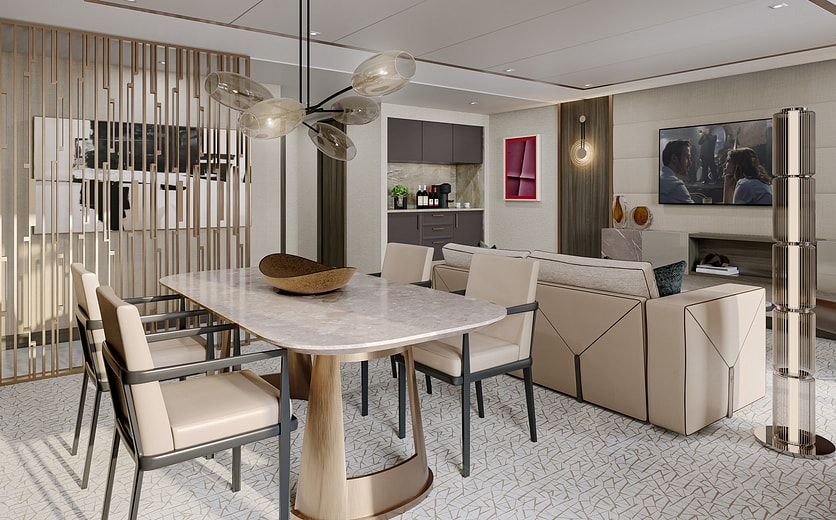
At 813-1,354 sq. ft., the thoughtfully designed Prestige Suites are the embodiment of refined living at sea. The one-bedroom, one-and-a-half bathroom suites are designed with calming hues of cream, gray and brown. They feature a dining table for in-suite service, a spacious closet and an elegant bath.
Ship renderings are artistic representations intended to provide a vision of the ship experience. Actual layouts, furnishings, and design elements may vary by deck, and specific location.





 0203 930 4640