Call
 Enquire
 Search



Menu

Manage my booking

| Sales | |
| Monday - Friday | 09:00 - 19:00 |
| Saturday | 09:00 - 16:00 |
| Sunday | 10:00 - 17:00 |
| Bank Holiday | 10:00 - 16:00 |
| Aftersales | |
| Monday - Friday | 09:00 - 17:30 |
| Bank Holiday | 10:00 - 16:00 |



09 Sept - 16 Sept 2027

7 Nights onboard Seven Seas Prestige

All Inclusive Drinks*

Water bottle*

Butler*

Room Service*

Soft drinks*

Speciality Dining*

Gratuities*

Shore Excursions*

Entertainment*

Wi-Fi*
Not Available
Not Available
Not Available
from
£7,389
per person
Our experts are here to help
Call us today on 0203 930 4640 or enquire online.





 Up to 45% Off Select 2026 & 2027 Sailings*A Low 7.5% Deposit on Select Sailings*Single Supplement Special*
*Select voyages. T's and C's apply
Day 1
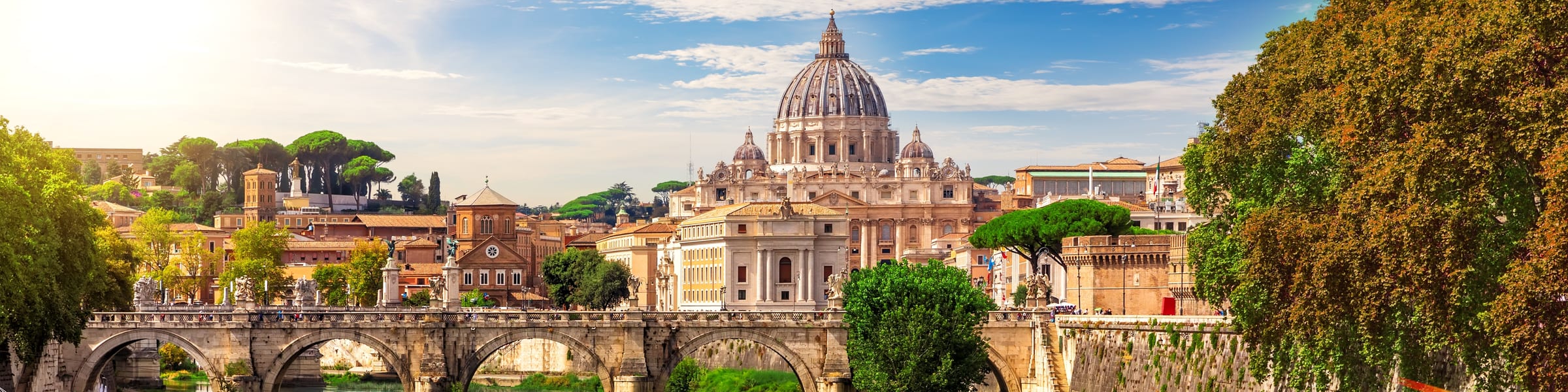
Italy's vibrant capital lives in the present, but no other city on earth evokes its past so powerfully. For over 2,500 years, emperors, popes, artists, and common citizens have left their mark here. Archaeological remains from ancient Rome, art-stuffed churches, and the treasures of Vatican City vie for your attention, but Rome is also a wonderful place to practice the Italian-perfected il dolce far niente, the sweet art of idleness. Your most memorable experiences may include sitting at a caffè in the Campo de' Fiori or strolling in a beguiling piazza.
Day 2
Salerno is an Italian city located on the Gulf of Salerno. Famous for being home to the first medical university, Salerno is a great destination for anyone looking for gorgeous sea views filled with sunshine and Italian food.
Day 3
Home to the Museo Regionale of Messina, known for featuring two of Caravaggio's paintings, the city is also famous for having been the capital of the ancient kingdom of Sicily.
Day 4
Day 5
Backed by imposing mountains, tiny Kotor lies hidden from the open sea, tucked into the deepest channel of the Bokor Kotorska (Kotor Bay), which is Europe's most southerly fjord. To many, this town is more charming than its sister UNESCO World Heritage Site, Dubrovnik, retaining more authenticity, but with fewer tourists and spared the war damage and subsequent rebuilding which has given Dubrovnik something of a Disney feel.Kotor's medieval Stari Grad (Old Town) is enclosed within well-preserved defensive walls built between the 9th and 18th centuries and is presided over by a proud hilltop fortress. Within the walls, a labyrinth of winding cobbled streets leads through a series of splendid paved piazzas, rimmed by centuries-old stone buildings. The squares are now haunted by strains from buskers but although many now house trendy cafés and chic boutiques, directions are still given medieval-style by reference to the town’s landmark churches.In the Middle Ages, as Serbia's chief port, Kotor was an important economic and cultural center with its own highly regarded schools of stonemasonry and iconography. From 1391 to 1420 it was an independent city-republic and later, it spent periods under Venetian, Austrian, and French rule, though it was undoubtedly the Venetians who left the strongest impression on the city's architecture. Since the breakup of Yugoslavia, some 70% of the stone buildings in the romantic Old Town have been snapped up by foreigners, mostly Brits and Russians. Porto Montenegro, a new marina designed to accommodate some of the world’s largest super yachts, opened in nearby Tivat in 2011, and along the bay are other charming seaside villages, all with better views of the bay than the vista from Kotor itself where the waterside is congested with cruise ships and yachts. Try sleepy Muo or the settlement of Prčanj in one direction around the bay, or Perast and the Roman mosaics of Risan in the other direction.
Day 6
Nothing can prepare you for your first sight of Dubrovnik. Lying 216 km (135 miles) southeast of Split and commanding a jaw-dropping coastal location, it is one of the world's most beautiful fortified cities. Its massive stone ramparts and fortress towers curve around a tiny harbor, enclosing graduated ridges of sun-bleached orange-tiled roofs, copper domes, and elegant bell towers. Your imagination will run wild picturing what it looked like seven centuries ago when the walls were built, without any suburbs or highways around it, just this magnificent stone city rising out of the sea.In the 7th century AD, residents of the Roman city Epidaurum (now Cavtat) fled the Avars and Slavs of the north and founded a new settlement on a small rocky island, which they named Laus, and later Ragusa. On the mainland hillside opposite the island, the Slav settlement called Dubrovnik grew up. In the 12th century the narrow channel separating the two settlements was filled in (now the main street through the Old Town, called Stradun), and Ragusa and Dubrovnik became one. The city was surrounded by defensive walls during the 13th century, and these were reinforced with towers and bastions in the late 15th century.From 1358 to 1808 the city thrived as a powerful and remarkably sophisticated independent republic, reaching its golden age during the 16th century. In 1667 many of its splendid Gothic and Renaissance buildings were destroyed by an earthquake. The defensive walls survived the disaster, and the city was rebuilt in baroque style.Dubrovnik lost its independence to Napoléon in 1808, and in 1815 passed to Austria-Hungary. During the 20th century, as part of Yugoslavia, the city became a popular tourist destination, and in 1979 it was listed as a UNESCO World Heritage Site. During the war for independence, it came under heavy siege. Thanks to careful restoration, few traces of damage remain; however, there are maps inside the Pile and Ploče Gates illustrating the points around the city where damage was done. It’s only when you experience Dubrovnik yourself that you can understand what a treasure the world nearly lost
Day 7
Water is the essence of Kvarner, and the region's largest city expresses this simply. Whether in Croatian or Italian (Fiume) the translation of the name to English is the same: river. Although the history of Croatia's third city goes back to the days of Imperial Rome, modern Rijeka evolved under the rule of Austria-Hungary. The historic core retains vestiges of the old Habsburg monarchy from the time when Rijeka served as the empire's outlet to the Adriatic. During the 1960s, under Yugoslavia, the suburbs expanded rapidly. Rijeka is the country's largest port, with a huge shipyard, massive dry-dock facilities, refineries, and other heavy industries offering large-scale employment. Since the breakup of Yugoslavia, however, Rijeka's role as a shipping town has declined significantly. Much business shifted north to the smaller Slovene ports during the crippling wars of the 1990s, and although some has returned, the volume remains less than half that seen in 1980.
Day 8
Up until the end of World War I, Trieste was the only port of the vast Austro-Hungarian Empire and therefore a major industrial and financial center. In the early years of the 20th century, Trieste and its surroundings also became famous by their association with some of the most important names of Italian literature, such as Italo Svevo, and English and German letters. James Joyce drew inspiration from the city's multiethnic population, and Rainer Maria Rilke was inspired by the seacoast west of the city. Although it has lost its importance as a port and a center of finance, it has never fully lost its roll as an intellectual center. The streets hold a mix of monumental, neoclassical, and art-nouveau architecture built by the Austrians during Trieste's days of glory, granting an air of melancholy stateliness to a city that lives as much in the past as the present.

from £7,389 per person
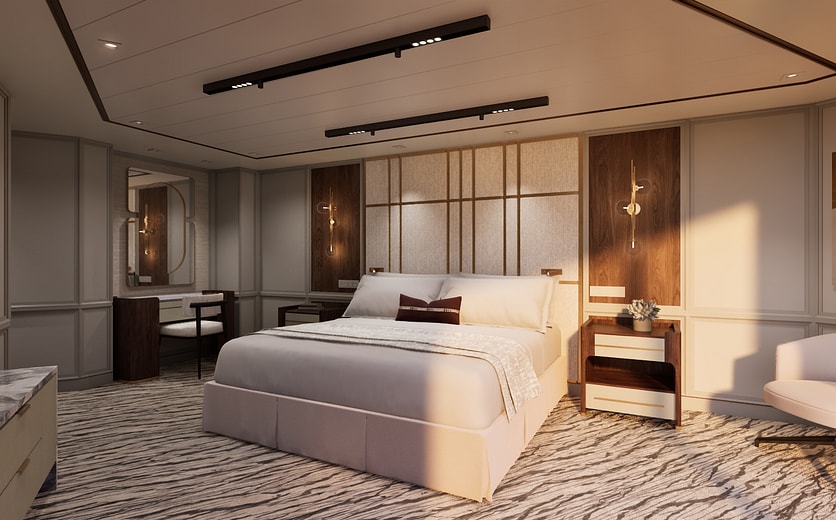
Ship renderings are artistic representations intended to provide a vision of the ship experience. Actual layouts, furnishings, and design elements may vary by deck, and specific location.
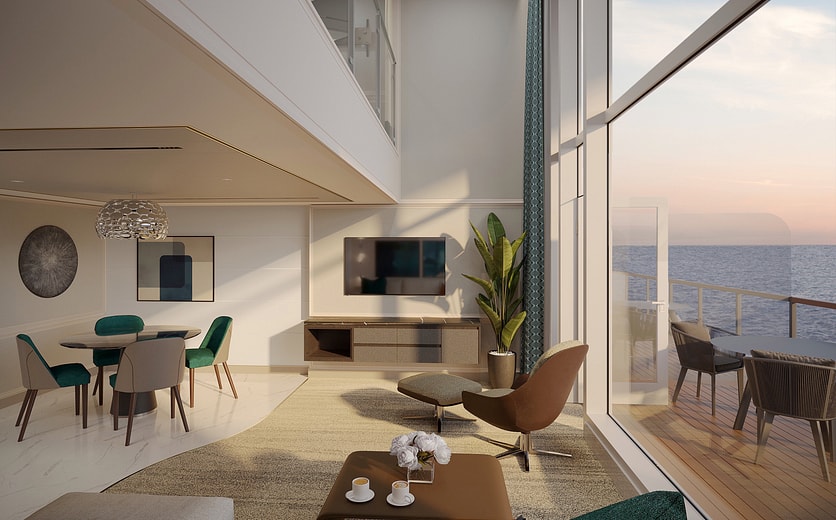
With their contemporary, sophisticated design, 4 double-story, 856 sq. ft. Grand Loft Suites evoke the feel of a refined Lower Manhattan residence. A dramatic double-height space and extraordinary window wall create jaw-dropping views from the upstairs loft bedroom, which faces directly toward the horizon. A neutral palette, tone-on-tone subtlety, and clean, tailored lines lend the suite a timeless yet modern character, with materials, fixtures, and fabrics carefully selected for their richness, comfort, and understated elegance.
Ship renderings are artistic representations intended to provide a vision of the ship experience. Actual layouts, furnishings, and design elements may vary by deck, and specific location.
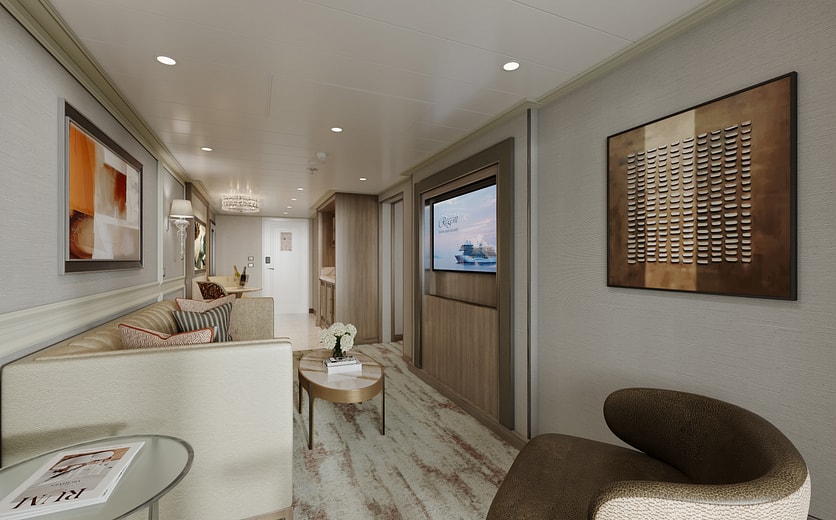
The Horizon Penthouse Suites on Seven Seas Prestige™ feature a beautifully appointed bedroom, a full bath suite, and a spacious living area. A standout feature in some of these suites is the oversized balcony—measuring up to 263 sq. ft.—which is part of the suite’s total size ranging from 600 sq. ft. to 726 sq. ft. This expansive outdoor space includes a dining area, plush sofa, and sun loungers, offering a perfect setting for open-air relaxation. With just 15 suites in this category, guests enjoy an exclusive experience that seamlessly blends indoor comfort with outdoor luxury.
Ship renderings are artistic representations intended to provide a vision of the ship experience. Actual layouts, furnishings, and design elements may vary by deck, and specific location.
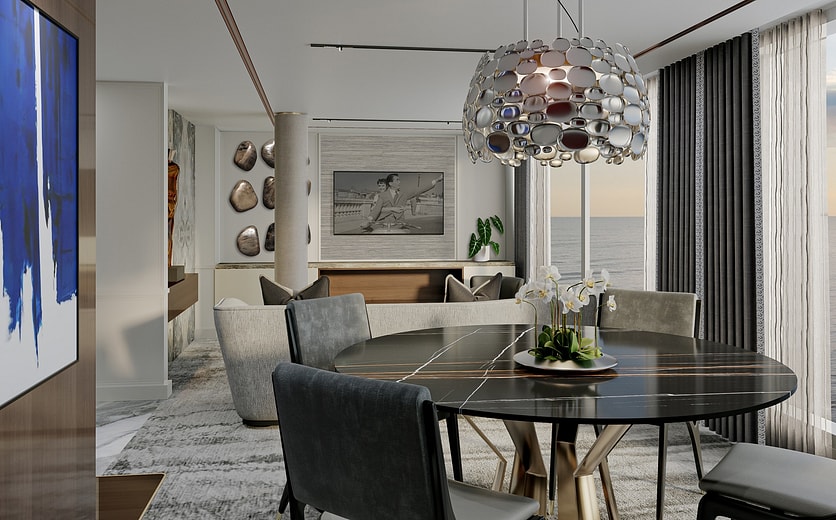
Offering a total of 2,037 sq. ft. the Signature Suites are outfitted with a rich color palette and the finest fabrics across two spacious bedrooms and two bathrooms, along with a generous living room. A private wraparound balcony — one of the largest at sea at 1,023 sq. ft. — extends the living space outdoors, making it ideal for entertaining or simply soaking in the view.
Ship renderings are artistic representations intended to provide a vision of the ship experience. Actual layouts, furnishings, and design elements may vary by deck, and specific location.
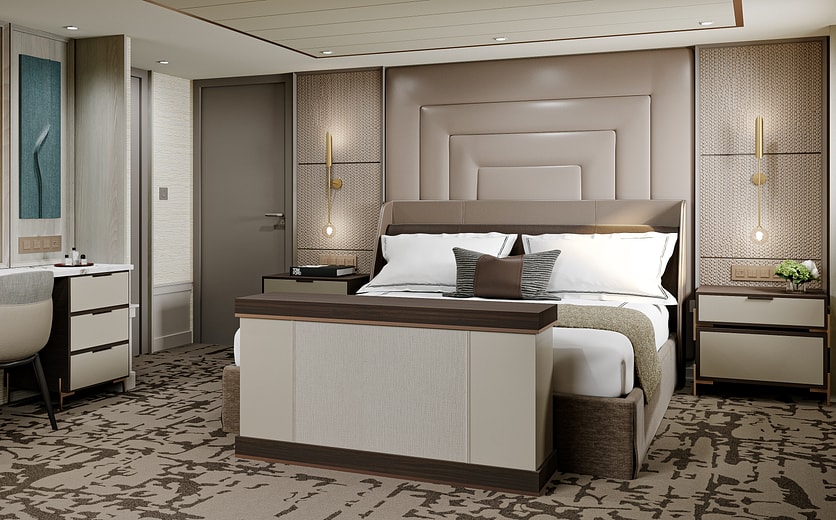
The Grand Suites feature clean lines, mid-century inspired furniture and a color palette that features neutrals with shades of green. The design highlights Italian artistry with textured fabrics and woven leather accents, creating a sophisticated and luxurious ambiance. At 1,214-1,417 sq. ft., the suite houses a private terrace as well as a dining room for in-suite meals.
Ship renderings are artistic representations intended to provide a vision of the ship experience. Actual layouts, furnishings, and design elements may vary by deck, and specific location.
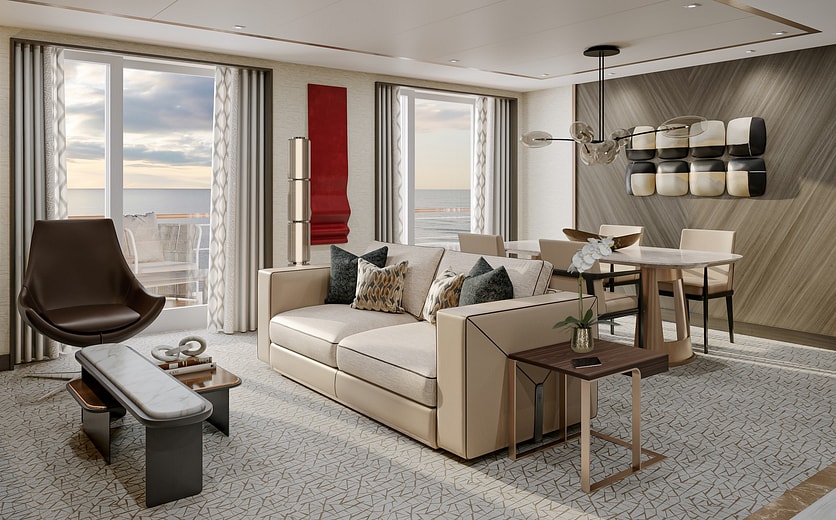
At 813-1,354 sq. ft., the thoughtfully designed Prestige Suites are the embodiment of refined living at sea. The one-bedroom, one-and-a-half bathroom suites are designed with calming hues of cream, gray and brown. They feature a dining table for in-suite service, a spacious closet and an elegant bath.
Ship renderings are artistic representations intended to provide a vision of the ship experience. Actual layouts, furnishings, and design elements may vary by deck, and specific location.
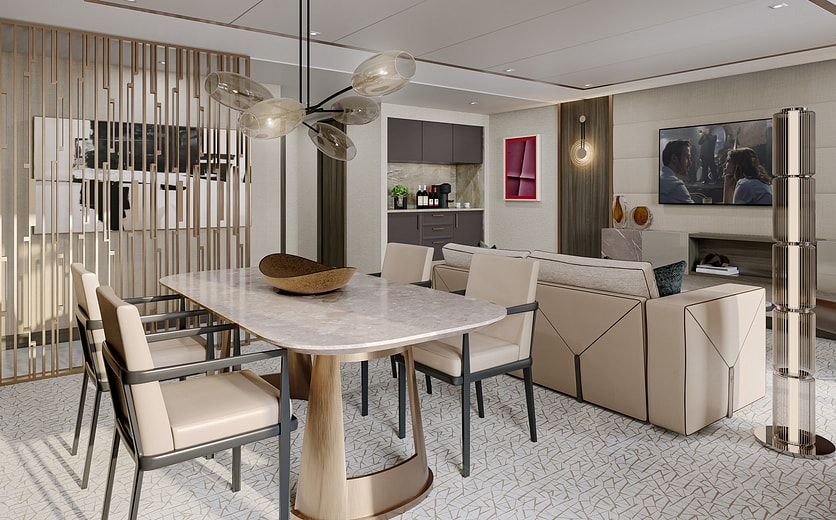
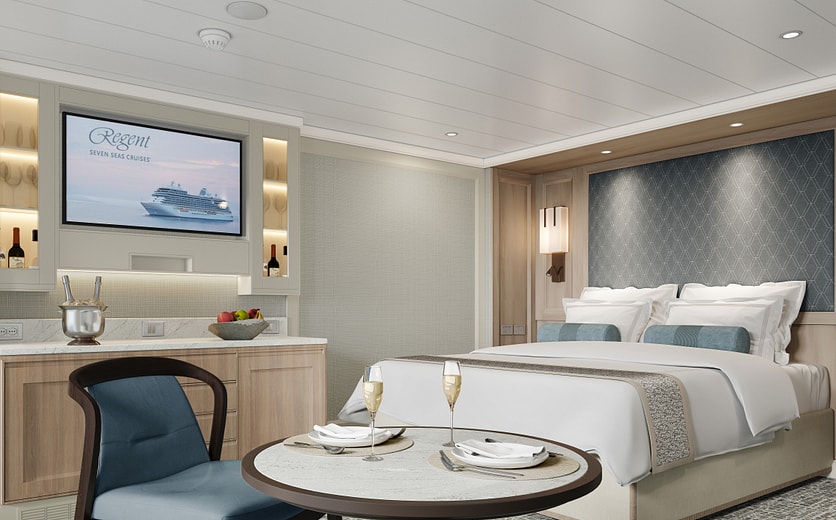
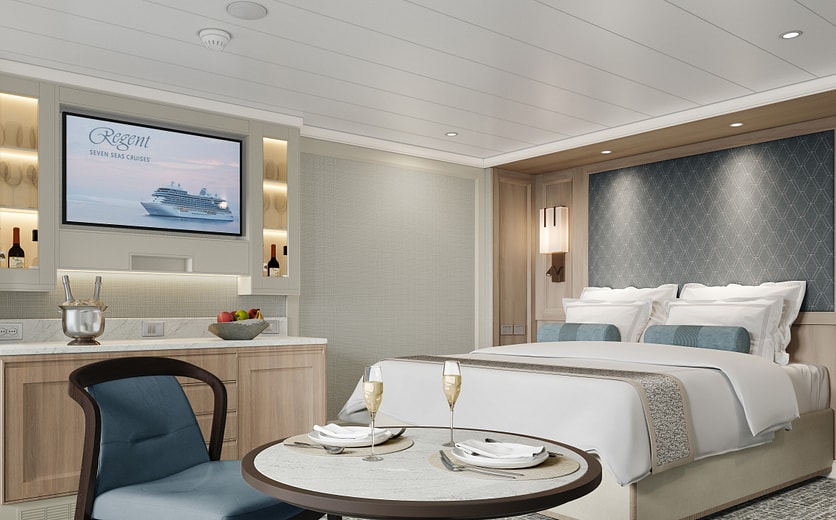
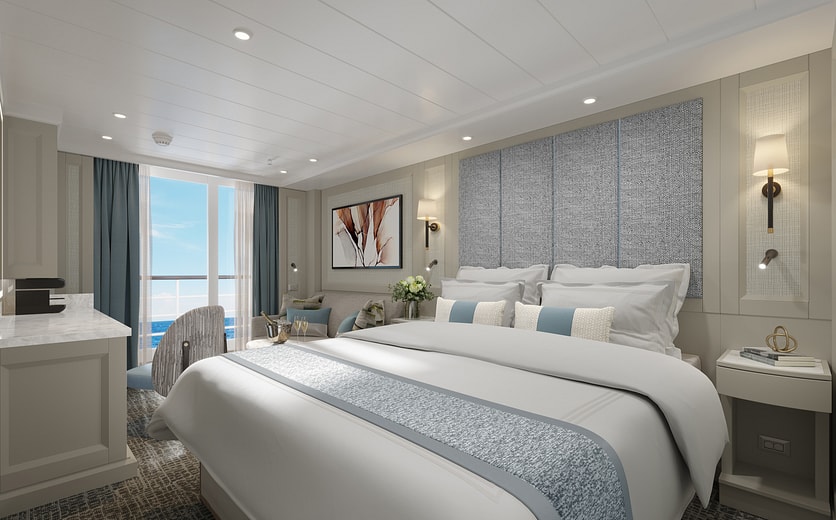
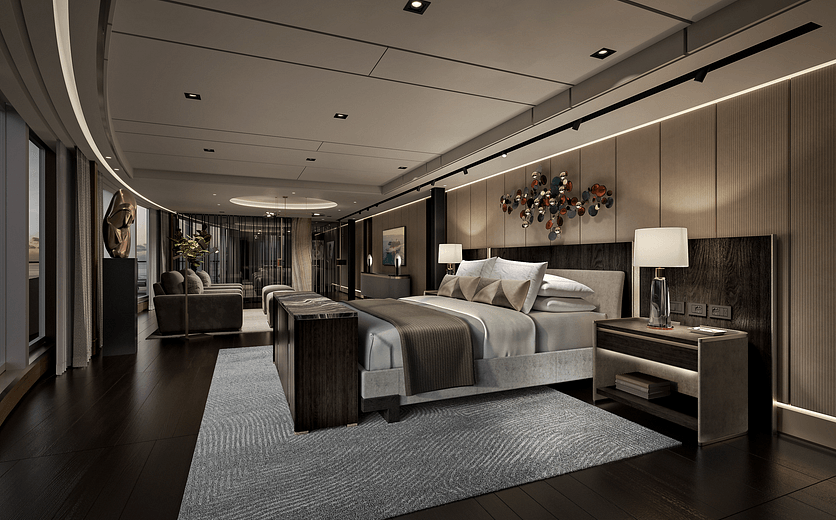
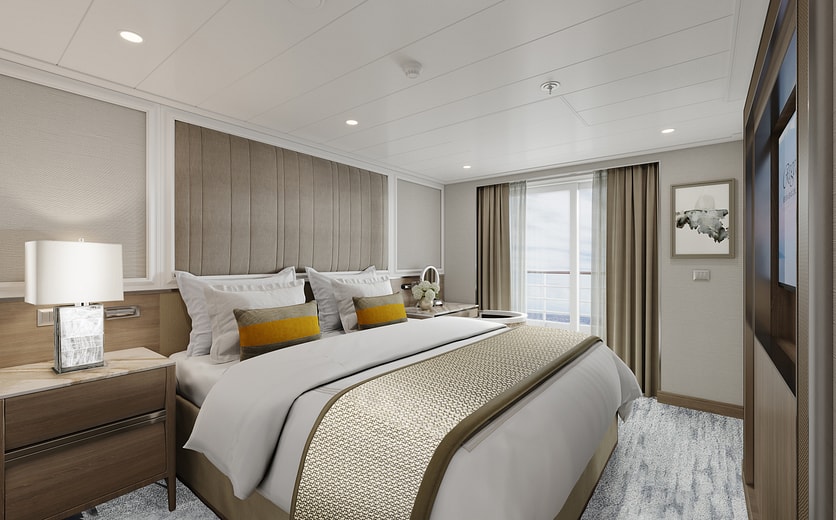
from £7,389 per person
Ship renderings are artistic representations intended to provide a vision of the ship experience. Actual layouts, furnishings, and design elements may vary by deck, and specific location.
With their contemporary, sophisticated design, 4 double-story, 856 sq. ft. Grand Loft Suites evoke the feel of a refined Lower Manhattan residence. A dramatic double-height space and extraordinary window wall create jaw-dropping views from the upstairs loft bedroom, which faces directly toward the horizon. A neutral palette, tone-on-tone subtlety, and clean, tailored lines lend the suite a timeless yet modern character, with materials, fixtures, and fabrics carefully selected for their richness, comfort, and understated elegance.
Ship renderings are artistic representations intended to provide a vision of the ship experience. Actual layouts, furnishings, and design elements may vary by deck, and specific location.
The Horizon Penthouse Suites on Seven Seas Prestige™ feature a beautifully appointed bedroom, a full bath suite, and a spacious living area. A standout feature in some of these suites is the oversized balcony—measuring up to 263 sq. ft.—which is part of the suite’s total size ranging from 600 sq. ft. to 726 sq. ft. This expansive outdoor space includes a dining area, plush sofa, and sun loungers, offering a perfect setting for open-air relaxation. With just 15 suites in this category, guests enjoy an exclusive experience that seamlessly blends indoor comfort with outdoor luxury.
Ship renderings are artistic representations intended to provide a vision of the ship experience. Actual layouts, furnishings, and design elements may vary by deck, and specific location.
Offering a total of 2,037 sq. ft. the Signature Suites are outfitted with a rich color palette and the finest fabrics across two spacious bedrooms and two bathrooms, along with a generous living room. A private wraparound balcony — one of the largest at sea at 1,023 sq. ft. — extends the living space outdoors, making it ideal for entertaining or simply soaking in the view.
Ship renderings are artistic representations intended to provide a vision of the ship experience. Actual layouts, furnishings, and design elements may vary by deck, and specific location.
The Grand Suites feature clean lines, mid-century inspired furniture and a color palette that features neutrals with shades of green. The design highlights Italian artistry with textured fabrics and woven leather accents, creating a sophisticated and luxurious ambiance. At 1,214-1,417 sq. ft., the suite houses a private terrace as well as a dining room for in-suite meals.
Ship renderings are artistic representations intended to provide a vision of the ship experience. Actual layouts, furnishings, and design elements may vary by deck, and specific location.
At 813-1,354 sq. ft., the thoughtfully designed Prestige Suites are the embodiment of refined living at sea. The one-bedroom, one-and-a-half bathroom suites are designed with calming hues of cream, gray and brown. They feature a dining table for in-suite service, a spacious closet and an elegant bath.
Ship renderings are artistic representations intended to provide a vision of the ship experience. Actual layouts, furnishings, and design elements may vary by deck, and specific location.





 0203 930 4640