Call
 Enquire
 Search



Menu

Manage my booking

| Sales | |
| Monday - Friday | 09:00 - 19:00 |
| Saturday | 09:00 - 16:00 |
| Sunday | 10:00 - 17:00 |
| Bank Holiday | 10:00 - 16:00 |
| Aftersales | |
| Monday - Friday | 09:00 - 17:30 |
| Bank Holiday | 10:00 - 16:00 |



01 Apr - 10 Apr 2029

9 Nights onboard Allura

Inclusion package upgrades available on request*

Soft drinks*

Complimentary Dining*

Gratuities*

Entertainment*

Wi-Fi*
Not Available
from
£2,879
per person
from
£2,879
per person
from
£4,759
per person
Our experts are here to help
Call us today on 0203 930 4640 or enquire online.




 Up to 50% off*Reduced Single Supplements*2027 around the world cruises*
*Select voyages. T's and C's apply
Day 1
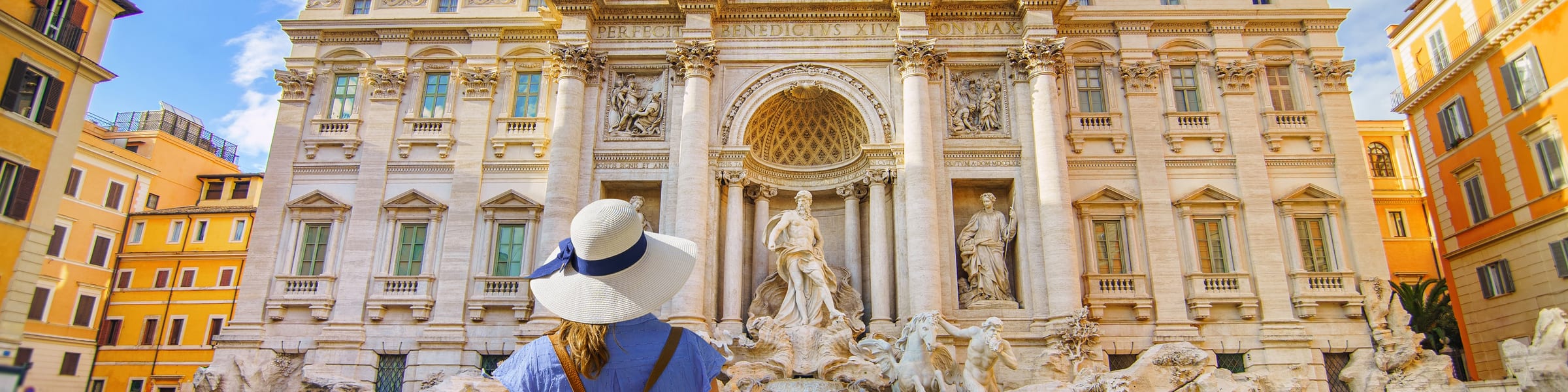
Italy's vibrant capital lives in the present, but no other city on earth evokes its past so powerfully. For over 2,500 years, emperors, popes, artists, and common citizens have left their mark here. Archaeological remains from ancient Rome, art-stuffed churches, and the treasures of Vatican City vie for your attention, but Rome is also a wonderful place to practice the Italian-perfected il dolce far niente, the sweet art of idleness. Your most memorable experiences may include sitting at a caffè in the Campo de' Fiori or strolling in a beguiling piazza.
Day 2
Livorno is a gritty city with a long and interesting history. In the early Middle Ages it alternately belonged to Pisa and Genoa. In 1421 Florence, seeking access to the sea, bought it. Cosimo I (1519–74) started construction of the harbor in 1571, putting Livorno on the map. After Ferdinando I de' Medici (1549–1609) proclaimed Livorno a free city, it became a haven for people suffering from religious persecution; Roman Catholics from England and Jews and Moors from Spain and Portugal, among others, settled here. The Quattro Mori (Four Moors), also known as the Monument to Ferdinando I, commemorates this. (The statue of Ferdinando I dates from 1595, the bronze Moors by Pietro Tacca from the 1620s.)In the following centuries, and particularly in the 18th, Livorno boomed as a port. In the 19th century the town drew a host of famous Britons passing through on their grand tours. Its prominence continued up to World War II, when it was heavily bombed. Much of the town's architecture, therefore, postdates the war, and it's somewhat difficult to imagine what it might have looked like before. Livorno has recovered from the war, however, as it's become a huge point of departure for container ships, as well as the only spot in Tuscany for cruise ships to dock for the day.Most of Livorno's artistic treasures date from the 17th century and aren't all that interesting unless you dote on obscure baroque artists. Livorno's most famous native artist, Amedeo Modigliani (1884–1920), was of much more recent vintage. Sadly, there's no notable work by him in his hometown.There may not be much in the way of art, but it's still worth strolling around the city. The Mercato Nuovo, which has been around since 1894, sells all sorts of fruits, vegetables, grains, meat, and fish. Outdoor markets nearby are also chock-full of local color. The presence of Camp Darby, an American military base just outside town, accounts for the availability of many American products.If you have time, Livorno is worth a stop for lunch or dinner at the very least.
Day 3
Livorno is a gritty city with a long and interesting history. In the early Middle Ages it alternately belonged to Pisa and Genoa. In 1421 Florence, seeking access to the sea, bought it. Cosimo I (1519–74) started construction of the harbor in 1571, putting Livorno on the map. After Ferdinando I de' Medici (1549–1609) proclaimed Livorno a free city, it became a haven for people suffering from religious persecution; Roman Catholics from England and Jews and Moors from Spain and Portugal, among others, settled here. The Quattro Mori (Four Moors), also known as the Monument to Ferdinando I, commemorates this. (The statue of Ferdinando I dates from 1595, the bronze Moors by Pietro Tacca from the 1620s.)In the following centuries, and particularly in the 18th, Livorno boomed as a port. In the 19th century the town drew a host of famous Britons passing through on their grand tours. Its prominence continued up to World War II, when it was heavily bombed. Much of the town's architecture, therefore, postdates the war, and it's somewhat difficult to imagine what it might have looked like before. Livorno has recovered from the war, however, as it's become a huge point of departure for container ships, as well as the only spot in Tuscany for cruise ships to dock for the day.Most of Livorno's artistic treasures date from the 17th century and aren't all that interesting unless you dote on obscure baroque artists. Livorno's most famous native artist, Amedeo Modigliani (1884–1920), was of much more recent vintage. Sadly, there's no notable work by him in his hometown.There may not be much in the way of art, but it's still worth strolling around the city. The Mercato Nuovo, which has been around since 1894, sells all sorts of fruits, vegetables, grains, meat, and fish. Outdoor markets nearby are also chock-full of local color. The presence of Camp Darby, an American military base just outside town, accounts for the availability of many American products.If you have time, Livorno is worth a stop for lunch or dinner at the very least.
Day 4
At first glance, it really doesn't look all that impressive. There's a pretty port with cafés charging €5 for a coffee and a picturesque old town in sugared-almond hues, but there are many prettier in the hills nearby. There are sandy beaches, rare enough on the Riviera, and old-fashioned squares with plane trees and pétanque players, but these are a dime a dozen throughout Provence. So what made St-Tropez an internationally known locale? Two words: Brigitte Bardot. When this pulpeuse (voluptuous) teenager showed up in St-Tropez on the arm of Roger Vadim in 1956 to film And God Created Woman, the heads of the world snapped around. Neither the gentle descriptions of writer Guy de Maupassant (1850–93), nor the watercolor tones of Impressionist Paul Signac (1863–1935), nor the stream of painters who followed (including Matisse and Bonnard) could focus the world's attention on this seaside hamlet as did this one sensual woman in a scarf, Ray-Bans, and capris. Vanity Fair ran a big article, "Saint Tropez Babylon," detailing the over-the-top petrodollar parties, megayachts, and Beyoncé–d paparazzi. But don't be turned off: the next year, Stewart, Tabori & Chang released an elegant coffee-table book, Houses of St-Tropez, packed with photos of supremely tasteful and pretty residences, many occupied by fashion designers, artists, and writers. Once a hangout for Colette, Anaïs Nin, and Françoise Sagan, the town still earns its old moniker, the "Montparnasse of the Mediterranean." Yet you might be surprised to find that this byword for billionaires is so small and insulated. The lack of train service, casinos, and chain hotels keeps it that way. Yet fame, in a sense, came too fast for St-Trop. Unlike the chic resorts farther east, it didn't have the decades-old reputation of the sort that would attract visitors all year around. For a good reason: its location on the south side of the gulf puts it at the mercy of the terrible mistral winter winds. So, in summer the crowds descend and the prices rise into the stratosphere. In July and August, you must be carefree about the sordid matter of cash. After all, at the most Dionysian nightclub in town, a glass of tap water goes for $37 and when the mojo really gets going, billionaires think nothing of "champagne-spraying" the partying crowds—think World Series celebrations but with $1,000 bottles of Roederer Cristal instead of Gatorade. Complaining about summer crowds, overpricing, and lack of customer service has become a tourist sport and yet this is what makes St-Tropez—described by the French daily newspaper Le Figaro as the place you can see "the greatest number of faces per square meter"—as intriguing as it is seductive.
Day 5
Day 6
The fishing village of Sète serves as gateway to Montpellier, in the North. Other noteworthy destinations in this area include Carcassone, Aigues Mortes, the Abbaye de Fontfroide, and Pezenas. For a look at the real fisherman's life, however, stay right where you are. Sète is the Mediterranean's biggest fishing port. Canals winding through town make it fun to stroll around, and there are a number of good walking paths leading to the beach (about 30 minutes to the west). Although it's small and unspectacular, Plage de la Corniche has calm, pristine waters that are perfect for swimming. For a panoramic view of the area, climb Mont St-Clair or Les Pierres Blanches and pick a beach to settle down on.
Day 7
If you look north of the cathedral (La Seu, or the seat of the bishopric, to Mallorcans) on a map of the city of Palma, you can see around the Plaça Santa Eulàlia a jumble of tiny streets that made up the earliest settlement. Farther out, a ring of wide boulevards traces the fortifications built by the Moors to defend the larger city that emerged by the 12th century. The zigzags mark the bastions that jutted out at regular intervals. By the end of the 19th century, most of the walls had been demolished; the only place where you can still see the massive defenses is at Ses Voltes, along the seafront west of the cathedral.A torrent (streambed) used to run through the middle of the old city, dry for most of the year but often a raging flood in the rainy season. In the 17th century it was diverted to the east, along the moat that ran outside the city walls. Two of Palma's main arteries, La Rambla and the Passeig d'es Born, now follow the stream's natural course. The traditional evening paseo (promenade) takes place on the Born.If you come to Palma by car, park in the garage beneath the Parc de la Mar (the ramp is just off the highway from the airport, as you reach the cathedral) and stroll along the park. Beside it run the huge bastions guarding the Almudaina Palace; the cathedral, golden and massive, rises beyond. Where you exit the garage, there's a ceramic mural by the late Catalan artist and Mallorca resident Joan Miró, facing the cathedral across the pool that runs the length of the park.If you begin early enough, a walk along the ramparts at Ses Voltes from the mirador beside the cathedral is spectacular. The first rays of the sun turn the upper pinnacles of La Seu bright gold and then begin to work their way down the sandstone walls. From the Parc de la Mar, follow Avinguda Antoni Maura past the steps to the palace. Just below the Plaça de la Reina, where the Passeig d'es Born begins, turn left on Carrer de la Boteria into the Plaça de la Llotja (if the Llotja itself is open, don't miss a chance to visit—it's the Mediterranean's finest Gothic-style civic building). From there stroll through the Plaça Drassana to the Museu d'Es Baluard, at the end of Carrer Sant Pere. Retrace your steps to Avinguda Antoni Maura. Walk up the Passeig d'es Born to Plaça Joan Carles I, then right on Avenida de La Unió.
Day 8
The provincial capital of the Valencian Community serves as a gateway to the huge influx of tourists that flock to the Costa Blanca resorts every year. Alicante is popular with holidaymakers who arrive for the warm, Mediterranean climate and seemingly endless golden beaches. However, there is much more to this city than sand and sun. With a picturesque waterfront, a hugely impressive castle, buzzing nightlife and a rich, complex history, Alicante is a fascinating destination all year round.
Day 9
Valencia, Spain's third-largest municipality, is a proud city with a thriving nightlife and restaurant scene, quality museums, and spectacular contemporary architecture, juxtaposed with a thoroughly charming historic quarter, making it a popular destination year in year out. During the Civil War, it was the last seat of the Republican Loyalist government (1935–36), holding out against Franco’s National forces until the country fell to 40 years of dictatorship. Today it represents the essence of contemporary Spain—daring design and architecture along with experimental cuisine—but remains deeply conservative and proud of its traditions. Though it faces the Mediterranean, Valencia's history and geography have been defined most significantly by the River Turia and the fertile huerta that surrounds it.The city has been fiercely contested ever since it was founded by the Greeks. El Cid captured Valencia from the Moors in 1094 and won his strangest victory here in 1099: he died in the battle, but his corpse was strapped into his saddle and so frightened the besieging Moors that it caused their complete defeat. In 1102 his widow, Jimena, was forced to return the city to Moorish rule; Jaume I finally drove them out in 1238. Modern Valencia was best known for its frequent disastrous floods until the River Turia was diverted to the south in the late 1950s. Since then the city has been on a steady course of urban beautification. The lovely bridges that once spanned the Turia look equally graceful spanning a wandering municipal park, and the spectacularly futuristic Ciutat de les Arts i les Ciències (City of Arts and Sciences), most of it designed by Valencia-born architect Santiago Calatrava, has at last created an exciting architectural link between this river town and the Mediterranean. If you're in Valencia, an excursion to Albufera Nature Park is a worthwhile day trip.
Day 10
The infinite variety of street life, the nooks and crannies of the medieval Barri Gòtic, the ceramic tile and stained glass of Art Nouveau facades, the art and music, the throb of street life, the food (ah, the food!)—one way or another, Barcelona will find a way to get your full attention. The capital of Catalonia is a banquet for the senses, with its beguiling mix of ancient and modern architecture, tempting cafés and markets, and sun-drenched Mediterranean beaches. A stroll along La Rambla and through waterfront Barceloneta, as well as a tour of Gaudí's majestic Sagrada Famíliaand his other unique creations, are part of a visit to Spain's second-largest city. Modern art museums and chic shops call for attention, too. Barcelona's vibe stays lively well into the night, when you can linger over regional wine and cuisine at buzzing tapas bars.

from £4,759 per person
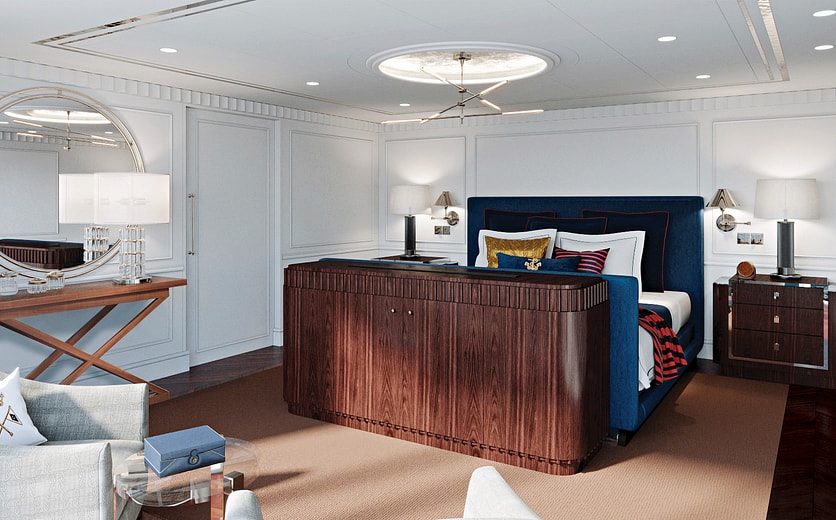
Allura’s three 2,400-square-foot+ Owner’s Suites span the full beam of the ship and boast expansive walls of glass that summon the sapphire seas beyond. Bathed in rays of the sun, these holiday retreats are styled exclusively in painstakingly selected fabrics, furnishings and design touches that exude opulence yet evoke the comforts of home to create a familiar luxury. Savor an in-suite repast in the elegant dining room and then indulge in convivial conversation within the stylish comfort of the inviting living area. In the spacious master bedroom, bask in ultimate relaxation with a plush king-size bed and a master bath featuring spa-caliber facilities. Expansive verandas off both the living room and master bedroom promise moments of cherished privacy as you survey the world from the pinnacle of luxurious living. Keep your eyes on the horizon for additional details on the Owner’s Suites’ curated decor.
+Owner’s Suite square footage varies according to deck location.
Owner's Suite Privileges
In addition to Stateroom Amenities
+Up to 20 garments per laundry bag; additional restrictions apply.
++Certain limitations apply.
Smoking in suites, staterooms and on verandas is strictly prohibited.
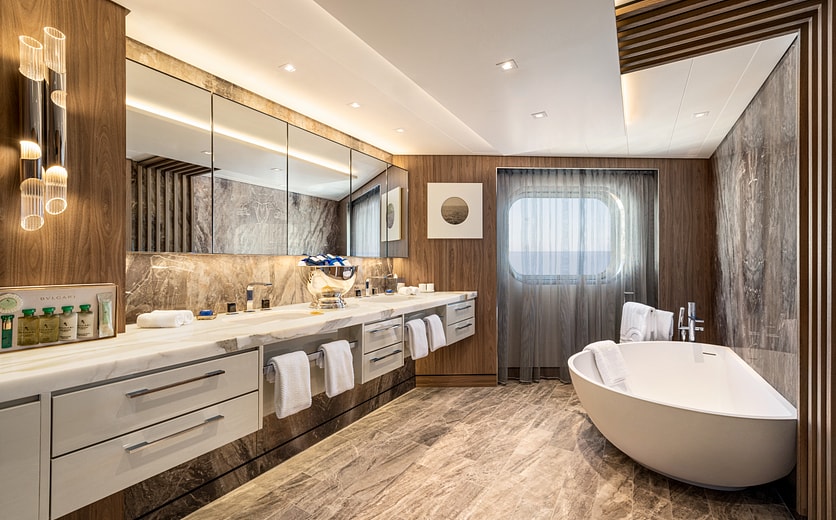
A proper vacation home always boasts a waterfront location, and the eight Vista Suites are no exception. Each features sweeping ocean views and measures 1,450 to nearly 1,850 square feet, creating a chic, spacious haven. As in any spectacular seaside home, the focus is on the world outside, with subtle tones evoking the indigo blues of the sea and luminescent cerulean sky. An airy living room, dining room, bar and master suite, all outfitted in gleaming marbles, dynamic granite and weathered oak, open to expansive teak verandas. A separate bathroom for guests offers every convenience when entertaining friends. The sublime bedroom features a plush king-size bed, spacious wardrobe and dressing area. A sun-dappled master bath with double vanities, a rainforest shower and a porcelain soaking tub rivals any shoreside home.
Vista Suite Privileges
In addition to Stateroom Amenities
+Up to 20 garments per laundry bag; additional restrictions apply.
++Certain limitations apply.
Smoking in suites, staterooms and on verandas is strictly prohibited.
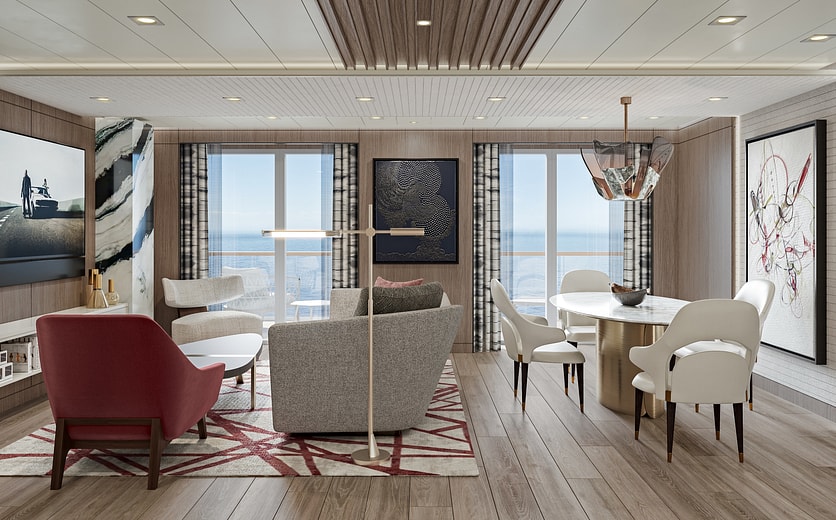
Inviting Metropolitan Residences
A smartly appointed flat on Central Park East is the inspiration for each of the 14 Oceania Suites. Informal, inviting and exquisite, these comfortable enclaves average approximately 1,000 to 1,200 square feet, providing ample space for gracious entertaining among the living and dining spaces’ thoughtfully curated residential furnishings. The glow of the emerald sea embraces the private teak veranda outside the living room and bedroom while a generous king-size bed and a soaking tub and shower in the marble-sheathed bathroom provide a respite from everyday cares. If the mood to entertains strikes, a cozy private study that can serve as a comfortable guest studio and a stylish guest bathroom stand ready.
Oceania Suite Privileges
In addition to Stateroom Amenities
Complimentary laundry service – up to 3 bags per stateroom+
+Up to 20 garments per laundry bag; additional restrictions apply.
++Certain limitations apply.
Smoking in suites, staterooms and on verandas is strictly prohibited.
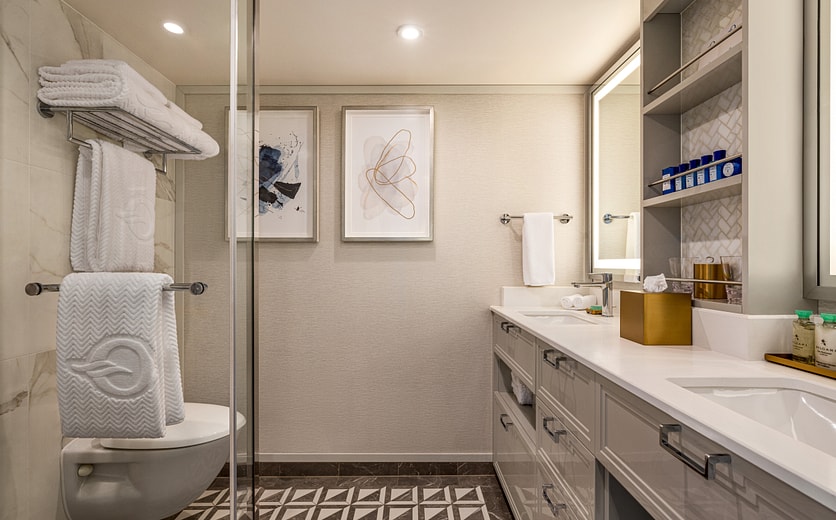
Enclaves in the Sky
Penthouses are, by design, reserved for those who appreciate the finer things in life. Appealing and with an abundance of space, the Penthouse Suite experience is both tranquil and familiar. Tony residential furnishings and a calming color palette are reminiscent of a home ashore, yet fine fabrics and rich upholstery soothing to the touch add a dash of exotic elegance. With everyday luxuries such as a walk-in closet and an oversized bathroom featuring dual vanities and a rainforest shower, every bit of the Penthouse Suite’s 440-square feet has been utilized. Lest one forget the location of this warm and inviting enclave, a captivating private veranda overlooks the everchanging seascape.
Penthouse Suite Privileges
In addition to Stateroom Amenities
Complimentary laundry service – up to 3 bags per stateroom+
Exclusive card-only access to private Executive Lounge staffed by a dedicated
Concierge featuring complimentary soft drinks, coffees and snacks throughout the day
24-hour Butler service
Complimentary welcome bottle of Champagne
Priority online specialty restaurant reservations
Unlimited access to Aquamar Spa Terrace
Complimentary Oceania Cruises logo tote bag
Cashmere lap blankets
Complimentary shoeshine service
Complimentary pressing of garments upon embarkation++
+Up to 20 garments per laundry bag; additional restrictions apply.
++Certain limitations apply.
Smoking in suites, staterooms and on verandas is strictly prohibited.
from £2,879 per person
from £2,879 per person
from £4,759 per person
Allura’s three 2,400-square-foot+ Owner’s Suites span the full beam of the ship and boast expansive walls of glass that summon the sapphire seas beyond. Bathed in rays of the sun, these holiday retreats are styled exclusively in painstakingly selected fabrics, furnishings and design touches that exude opulence yet evoke the comforts of home to create a familiar luxury. Savor an in-suite repast in the elegant dining room and then indulge in convivial conversation within the stylish comfort of the inviting living area. In the spacious master bedroom, bask in ultimate relaxation with a plush king-size bed and a master bath featuring spa-caliber facilities. Expansive verandas off both the living room and master bedroom promise moments of cherished privacy as you survey the world from the pinnacle of luxurious living. Keep your eyes on the horizon for additional details on the Owner’s Suites’ curated decor.
+Owner’s Suite square footage varies according to deck location.
Owner's Suite Privileges
In addition to Stateroom Amenities
+Up to 20 garments per laundry bag; additional restrictions apply.
++Certain limitations apply.
Smoking in suites, staterooms and on verandas is strictly prohibited.
A proper vacation home always boasts a waterfront location, and the eight Vista Suites are no exception. Each features sweeping ocean views and measures 1,450 to nearly 1,850 square feet, creating a chic, spacious haven. As in any spectacular seaside home, the focus is on the world outside, with subtle tones evoking the indigo blues of the sea and luminescent cerulean sky. An airy living room, dining room, bar and master suite, all outfitted in gleaming marbles, dynamic granite and weathered oak, open to expansive teak verandas. A separate bathroom for guests offers every convenience when entertaining friends. The sublime bedroom features a plush king-size bed, spacious wardrobe and dressing area. A sun-dappled master bath with double vanities, a rainforest shower and a porcelain soaking tub rivals any shoreside home.
Vista Suite Privileges
In addition to Stateroom Amenities
+Up to 20 garments per laundry bag; additional restrictions apply.
++Certain limitations apply.
Smoking in suites, staterooms and on verandas is strictly prohibited.
Inviting Metropolitan Residences
A smartly appointed flat on Central Park East is the inspiration for each of the 14 Oceania Suites. Informal, inviting and exquisite, these comfortable enclaves average approximately 1,000 to 1,200 square feet, providing ample space for gracious entertaining among the living and dining spaces’ thoughtfully curated residential furnishings. The glow of the emerald sea embraces the private teak veranda outside the living room and bedroom while a generous king-size bed and a soaking tub and shower in the marble-sheathed bathroom provide a respite from everyday cares. If the mood to entertains strikes, a cozy private study that can serve as a comfortable guest studio and a stylish guest bathroom stand ready.
Oceania Suite Privileges
In addition to Stateroom Amenities
Complimentary laundry service – up to 3 bags per stateroom+
+Up to 20 garments per laundry bag; additional restrictions apply.
++Certain limitations apply.
Smoking in suites, staterooms and on verandas is strictly prohibited.
Enclaves in the Sky
Penthouses are, by design, reserved for those who appreciate the finer things in life. Appealing and with an abundance of space, the Penthouse Suite experience is both tranquil and familiar. Tony residential furnishings and a calming color palette are reminiscent of a home ashore, yet fine fabrics and rich upholstery soothing to the touch add a dash of exotic elegance. With everyday luxuries such as a walk-in closet and an oversized bathroom featuring dual vanities and a rainforest shower, every bit of the Penthouse Suite’s 440-square feet has been utilized. Lest one forget the location of this warm and inviting enclave, a captivating private veranda overlooks the everchanging seascape.
Penthouse Suite Privileges
In addition to Stateroom Amenities
Complimentary laundry service – up to 3 bags per stateroom+
Exclusive card-only access to private Executive Lounge staffed by a dedicated
Concierge featuring complimentary soft drinks, coffees and snacks throughout the day
24-hour Butler service
Complimentary welcome bottle of Champagne
Priority online specialty restaurant reservations
Unlimited access to Aquamar Spa Terrace
Complimentary Oceania Cruises logo tote bag
Cashmere lap blankets
Complimentary shoeshine service
Complimentary pressing of garments upon embarkation++
+Up to 20 garments per laundry bag; additional restrictions apply.
++Certain limitations apply.
Smoking in suites, staterooms and on verandas is strictly prohibited.
from £2,879 per person
from £2,879 per person





 0203 930 4640