Call
Call Enquire
 Search


Menu

Manage my booking

| Sales | |
| Monday - Friday | 09:00 - 20:00 |
| Saturday | 09:00 - 16:00 |
| Sunday | 10:00 - 17:00 |
| Bank Holiday | 10:00 - 16:00 |
| Aftersales | |
| Monday - Friday | 09:00 - 17:30 |
| Bank Holiday | 10:00 - 16:00 |

 0203 930 4640


27 Oct - 05 Nov 2027

9 Nights onboard Star Clipper

Water sports toys*
Complimentary Dining*

Entertainment*
from
£3,040
per person
from
£3,280
per person
Not Available
Not Available
Our experts are here to help
Call us today on 0203 930 4640 or enquire online.



Day 1
As you sail into Malaga you will notice what an idyllic setting the city enjoys on the famous Costa del Sol. To the east of this provincial capital, the coast along the region of La Axarqua is scattered with villages, farmland and sleepy fishing hamlets - the epitome of traditional rural Spain. To the west stretches a continuous city where the razzmatazz and bustle creates a colourful contrast that is easily recognisable as the Costa del Sol. Surrounding the region, the Penibéetica Mountains provide an attractive backdrop overlooking the lower terraced slopes which yield olives and almonds. This spectacular mountain chain shelters the province from cold northerly winds, giving it a reputation as a therapeutic and exotic place in which to escape from cold northern climes. Malaga is also the gateway to many of Andalusia's enchanting historic villages, towns and cities.
Day 2
The autonomous city of Ceuta is a tiny Spanish city-enclave on the Moroccan side of the Straits of Gibraltar, separated from the Spanish mainland by just 12 miles. The city's strategic location has ensured it has endured a turbulent history, often being used as a trade and military outpost. Originally an old Carthaginian colony, it has since been held by the Romans, Vandals, Byzantines, and Arabs, and has been known as 'Abyla', 'Septem' and 'Cibta'. It was finally taken over by Spain in 1580 and has remained Spanish since then, with the name 'Ceuta'. Covering an area of just ten square miles, the enclave is dominated by the hill of Monte Hacho, sometimes believed to be the legendary Pillars of Hercules. With a fascinating mix of both Spanish and African influences and surrounded by massive 14th-century city walls, Ceuta has a charm and grandeur all of its own. As an autonomous region of Spain, Ceuta is part of the territory of the EU, but is considered a special low-tax zone. Leather goods, ceramics and embroidery are common purchases from the city.
Day 3
Believed to be the oldest town on the Iberian Peninsula, the Andalusian port of Cádiz enjoys a stunning location at the edge of a six-mile promontory. The town itself, with 3,000 years of history, is characterised by pretty white houses with balconies often adorned with colourful flowers. As you wander around be sure to take a stroll through the sizeable Plaza de Espãna, with its large monument dedicated to the first Spanish constitution, which was signed here in 1812. Cádiz has two pleasant seafront promenades which boast fine views of the Atlantic Ocean, and has a lovely park, the Parque Genoves, located close to the sea with an open-air theatre and attractive palm garden. Also notable is the neo-Classical cathedral, capped by a golden dome.
Day 4
Tangier can trace its origins back to the Phoenicians and ancient Greeks. It was named after Tinge, the mother of Hercules’ son, and its beginnings are embedded in mythology. It was subsequently a Roman province, and after Vandal and Byzantine influences, was occupied by the Arabs with Spain, Portugal, France and England also playing a part in the city’s history. With such a diverse past it is perhaps not surprising that Tangier is such an individual city. Overlooking the Straits of Gibraltar, the city lies on a bay between two promontories. With its old Kasbah, panoramic views, elegant buildings, squares and places of interest, there is much to discover in both the new and old parts of the city.
Day 5
The original settlement formed on the site of Casablanca by the Berbers became the kingdom of Anfa, and during the 15th century harboured pirates who raided the Portuguese coast. In retaliation for the attacks, the Portuguese destroyed Anfa and founded the town they called Casa Branca (white house). They remained here until an earthquake in 1755 and the town was subsequently rebuilt by Mohammed ben Abdallah, whose legacy of mosques and houses can still be seen in the old Medina. Casablanca acquired its present-day name when the Spanish obtained special port privileges in 1781. The French landed here in 1907, later establishing a protectorate and modelling the town on the port of Marseilles. Today Casablanca is Morocco’s largest city, its most significant port and the centre of commerce and industry. The city is a vibrant fusion of European, African and Arabian influences and its French colonial architecture and art deco buildings seamlessly blend in with the busy, colourful markets. Please note that vendors in the souks can be very persistent and eager to make a sale.
Day 6
Day 7
Day 8
A volcanic island designated a UNESCO Biosphere Reserve, Lanzarote’s dramatic landscapes were shaped by an explosive past. Today, its pretty beaches and virtual absence of rain together with duty-free shopping make the island an extremely desirable destination. The main port and capital, Arrecife, is a pleasant town with a modern seafront and colourful gardens. Outside the capital there is plenty to explore, from the dazzling white salt flats of Janubio and the rugged terrain of Fire Mountain to the eerie caves of Los Verdes and an array of unspoilt fishing villages scattered around the coast. The island is home to a great selection of restaurants and local specialities including garbanzos compuestos – a chickpea stew; papas arrugadas – potatoes with carrots, peas, ham and green pepper; and of course, plenty of fresh seafood. Please note that those planning to participate in one of the shore excursions from this port may need to take an early lunch on board ship to suit the excursion schedules.
Day 9
The second-largest of the Canaries after Tenerife, Fuerteventura is geologically the oldest of all the islands in the archipelago. It has the longest coastline and is blessed with gentle valleys and sweeping plains. Near the capital, Puerto del Rosario, there are lovely beaches, and other beaches in the north and south of the island can be compared with the best in the world. Among the features of the island are its windmills, dotted around the landscape - evidence of the island's traditional agriculture. Puerto del Rosario, the capital, is on the east coast and was originally a watering-hole used by local farmers for their goats. In the early 19th century, Maria Estrada opened a tavern here, which paved the way for the development of the port. It has been the island’s capital since 1860. Among its attractions are the old harbour area, with its narrow alleyways lined with picturesque Canarian-style houses, and the Church of Nuestra Senora del Rosario.
Day 10
Perhaps the prettiest of the Canary Islands, Gran Canaria is an almost circular isle with the peak of Pozo de Las Nieves, its highest point, at the centre. With a wealth of natural beauty and all the exciting attractions of city life in the capital, the island offers the best of both worlds. You will no doubt wish to see the sights of the capital’s old quarter, which dates back to the 15th century and encompassses the Vegueta and Triana districts, and wherever you go you can enjoy the glorious subtropical climate, perfect for growing exotic palms and fruits.

from £3,040 per person
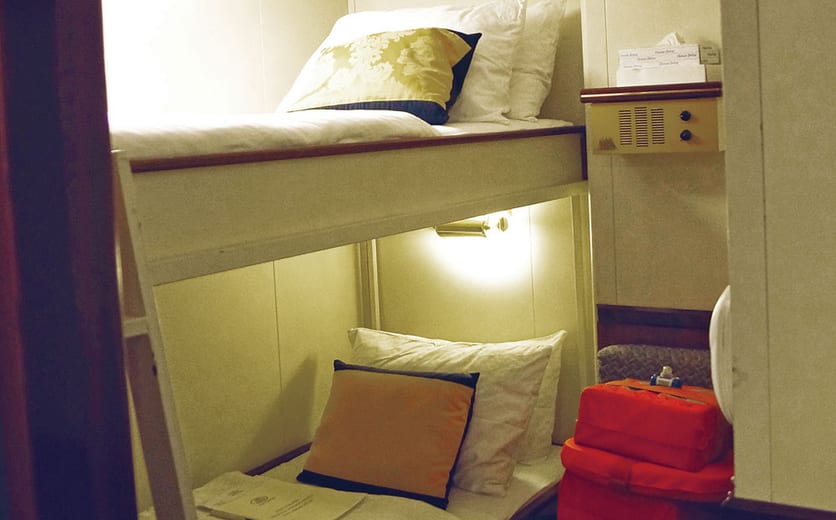
Category 6 cabins feature upper/lower beds and a bathroom with shower. Each cabins include air conditioning, hair dryers, private safe, television, DVD player, telephone and other amenities an experienced traveller has come to expect.
from £3,280 per person
from £3,040 per person
Category 6 cabins feature upper/lower beds and a bathroom with shower. Each cabins include air conditioning, hair dryers, private safe, television, DVD player, telephone and other amenities an experienced traveller has come to expect.
from £3,280 per person