Call
 Enquire
 Search



Menu

Manage my booking

| Sales | |
| Monday - Friday | 09:00 - 19:00 |
| Saturday | 09:00 - 16:00 |
| Sunday | 10:00 - 17:00 |
| Bank Holiday | 10:00 - 16:00 |
| Aftersales | |
| Monday - Friday | 09:00 - 17:30 |
| Bank Holiday | 10:00 - 16:00 |



08 Jun - 26 Jun 2027

18 Nights onboard Seven Seas Prestige

All Inclusive Drinks*

Water bottle*

Butler*

Room Service*

Soft drinks*

Speciality Dining*

Gratuities*

Shore Excursions*

Entertainment*

Wi-Fi*
Not Available
Not Available
Not Available
from
£16,109
per person
Our experts are here to help
Call us today on 0203 930 4640 or enquire online.




 Up to 45% Off Select 2026 & 2027 Sailings*A Low 7.5% Deposit on Select Sailings*Single Supplement Special*
*Select voyages. T's and C's apply
Day 1
Set on seven hills on the banks of the River Tagus, Lisbon has been the capital of Portugal since the 13th century. It is a city famous for its majestic architecture, old wooden trams, Moorish features and more than twenty centuries of history. Following disastrous earthquakes in the 18th century, Lisbon was rebuilt by the Marques de Pombal who created an elegant city with wide boulevards and a great riverfront and square, Praça do Comércio. Today there are distinct modern and ancient sections, combining great shopping with culture and sightseeing in the Old Town, built on the city's terraced hillsides. The distance between the ship and your tour vehicle may vary. This distance is not included in the excursion grades.
Day 2
Portimão is a major fishing port, and significant investment has been poured into transforming it into an attractive cruise port as well. The city itself is spacious and has several good shopping streets—though sadly many of the more traditional retailers have closed in the wake of the global economic crisis. There is also a lovely riverside area that just begs to be strolled (lots of the coastal cruises depart from here). Don’t leave without stopping for an alfresco lunch at the Doca da Sardinha ("sardine dock") between the old bridge and the railway bridge. You can sit at one of many inexpensive establishments, eating charcoal-grilled sardines (a local specialty) accompanied by chewy fresh bread, simple salads, and local wine.
Day 3
Believed to be the oldest town on the Iberian Peninsula, the Andalusian port of Cádiz enjoys a stunning location at the edge of a six-mile promontory. The town itself, with 3,000 years of history, is characterised by pretty white houses with balconies often adorned with colourful flowers. As you wander around be sure to take a stroll through the sizeable Plaza de Espãna, with its large monument dedicated to the first Spanish constitution, which was signed here in 1812. Cádiz has two pleasant seafront promenades which boast fine views of the Atlantic Ocean, and has a lovely park, the Parque Genoves, located close to the sea with an open-air theatre and attractive palm garden. Also notable is the neo-Classical cathedral, capped by a golden dome.
Day 4
Tangier can trace its origins back to the Phoenicians and ancient Greeks. It was named after Tinge, the mother of Hercules’ son, and its beginnings are embedded in mythology. It was subsequently a Roman province, and after Vandal and Byzantine influences, was occupied by the Arabs with Spain, Portugal, France and England also playing a part in the city’s history. With such a diverse past it is perhaps not surprising that Tangier is such an individual city. Overlooking the Straits of Gibraltar, the city lies on a bay between two promontories. With its old Kasbah, panoramic views, elegant buildings, squares and places of interest, there is much to discover in both the new and old parts of the city.
Day 5
As you sail into Malaga you will notice what an idyllic setting the city enjoys on the famous Costa del Sol. To the east of this provincial capital, the coast along the region of La Axarqua is scattered with villages, farmland and sleepy fishing hamlets - the epitome of traditional rural Spain. To the west stretches a continuous city where the razzmatazz and bustle creates a colourful contrast that is easily recognisable as the Costa del Sol. Surrounding the region, the Penibéetica Mountains provide an attractive backdrop overlooking the lower terraced slopes which yield olives and almonds. This spectacular mountain chain shelters the province from cold northerly winds, giving it a reputation as a therapeutic and exotic place in which to escape from cold northern climes. Malaga is also the gateway to many of Andalusia's enchanting historic villages, towns and cities.
Day 6
Day 7
The provincial capital of the Valencian Community serves as a gateway to the huge influx of tourists that flock to the Costa Blanca resorts every year. Alicante is popular with holidaymakers who arrive for the warm, Mediterranean climate and seemingly endless golden beaches. However, there is much more to this city than sand and sun. With a picturesque waterfront, a hugely impressive castle, buzzing nightlife and a rich, complex history, Alicante is a fascinating destination all year round.
Day 8
Hedonistic and historic, Eivissa (Ibiza, in Castilian) is a city jam-packed with cafés, nightspots, and trendy shops; looming over it are the massive stone walls of Dalt Vila —the medieval city declared a UNESCO World Heritage site in 1999—and its Gothic cathedral. Squeezed between the north walls of the old city and the harbor is Sa Penya, a long labyrinth of stone-paved streets that offer some of the city's best offbeat shopping, snacking, and exploring. The tourist information office on Vara de Rey has a useful map of walks through the old city.
Day 9
If you look north of the cathedral (La Seu, or the seat of the bishopric, to Mallorcans) on a map of the city of Palma, you can see around the Plaça Santa Eulàlia a jumble of tiny streets that made up the earliest settlement. Farther out, a ring of wide boulevards traces the fortifications built by the Moors to defend the larger city that emerged by the 12th century. The zigzags mark the bastions that jutted out at regular intervals. By the end of the 19th century, most of the walls had been demolished; the only place where you can still see the massive defenses is at Ses Voltes, along the seafront west of the cathedral.A torrent (streambed) used to run through the middle of the old city, dry for most of the year but often a raging flood in the rainy season. In the 17th century it was diverted to the east, along the moat that ran outside the city walls. Two of Palma's main arteries, La Rambla and the Passeig d'es Born, now follow the stream's natural course. The traditional evening paseo (promenade) takes place on the Born.If you come to Palma by car, park in the garage beneath the Parc de la Mar (the ramp is just off the highway from the airport, as you reach the cathedral) and stroll along the park. Beside it run the huge bastions guarding the Almudaina Palace; the cathedral, golden and massive, rises beyond. Where you exit the garage, there's a ceramic mural by the late Catalan artist and Mallorca resident Joan Miró, facing the cathedral across the pool that runs the length of the park.If you begin early enough, a walk along the ramparts at Ses Voltes from the mirador beside the cathedral is spectacular. The first rays of the sun turn the upper pinnacles of La Seu bright gold and then begin to work their way down the sandstone walls. From the Parc de la Mar, follow Avinguda Antoni Maura past the steps to the palace. Just below the Plaça de la Reina, where the Passeig d'es Born begins, turn left on Carrer de la Boteria into the Plaça de la Llotja (if the Llotja itself is open, don't miss a chance to visit—it's the Mediterranean's finest Gothic-style civic building). From there stroll through the Plaça Drassana to the Museu d'Es Baluard, at the end of Carrer Sant Pere. Retrace your steps to Avinguda Antoni Maura. Walk up the Passeig d'es Born to Plaça Joan Carles I, then right on Avenida de La Unió.
Day 10
The infinite variety of street life, the nooks and crannies of the medieval Barri Gòtic, the ceramic tile and stained glass of Art Nouveau facades, the art and music, the throb of street life, the food (ah, the food!)—one way or another, Barcelona will find a way to get your full attention. The capital of Catalonia is a banquet for the senses, with its beguiling mix of ancient and modern architecture, tempting cafés and markets, and sun-drenched Mediterranean beaches. A stroll along La Rambla and through waterfront Barceloneta, as well as a tour of Gaudí's majestic Sagrada Famíliaand his other unique creations, are part of a visit to Spain's second-largest city. Modern art museums and chic shops call for attention, too. Barcelona's vibe stays lively well into the night, when you can linger over regional wine and cuisine at buzzing tapas bars.
Day 11
Considered Corsica’s primary commercial and cultural hub, the largest city and regional capital of Ajaccio is situated on the west coast of the island, approximately 644 km (400 miles) southeast of Marseille, France. Founded in 1492, vestiges of ancient Corsica in this ville impériale revolve around the city’s most famous son, Napoléon Bonaparte, whose family home—now the national museum Maison Bonaparte—pays tribute to the emperor’s historical influence.Remnants from what was originally a 12th-century Genoese colony are still visible around the Old Town near the imposing citadel and watchtower. Perfect for exploring, the luminous seaside city surrounded by snowcapped mountains and pretty beaches offers numerous sites, eateries, side streets, and a popular harbor, where sailboats and fishing vessels moor in the picturesque Tino Rossi port lined with well-established restaurants and cafés serving fresh local fare.
Day 12
Day 13
Villefranche-Sur-Mer is located on the Côte d’Azur in Provence – known for its fields of lavender and warm weather – and is highly appreciated for its 14th Century architecture.
Day 14
Livorno is a gritty city with a long and interesting history. In the early Middle Ages it alternately belonged to Pisa and Genoa. In 1421 Florence, seeking access to the sea, bought it. Cosimo I (1519–74) started construction of the harbor in 1571, putting Livorno on the map. After Ferdinando I de' Medici (1549–1609) proclaimed Livorno a free city, it became a haven for people suffering from religious persecution; Roman Catholics from England and Jews and Moors from Spain and Portugal, among others, settled here. The Quattro Mori (Four Moors), also known as the Monument to Ferdinando I, commemorates this. (The statue of Ferdinando I dates from 1595, the bronze Moors by Pietro Tacca from the 1620s.)In the following centuries, and particularly in the 18th, Livorno boomed as a port. In the 19th century the town drew a host of famous Britons passing through on their grand tours. Its prominence continued up to World War II, when it was heavily bombed. Much of the town's architecture, therefore, postdates the war, and it's somewhat difficult to imagine what it might have looked like before. Livorno has recovered from the war, however, as it's become a huge point of departure for container ships, as well as the only spot in Tuscany for cruise ships to dock for the day.Most of Livorno's artistic treasures date from the 17th century and aren't all that interesting unless you dote on obscure baroque artists. Livorno's most famous native artist, Amedeo Modigliani (1884–1920), was of much more recent vintage. Sadly, there's no notable work by him in his hometown.There may not be much in the way of art, but it's still worth strolling around the city. The Mercato Nuovo, which has been around since 1894, sells all sorts of fruits, vegetables, grains, meat, and fish. Outdoor markets nearby are also chock-full of local color. The presence of Camp Darby, an American military base just outside town, accounts for the availability of many American products.If you have time, Livorno is worth a stop for lunch or dinner at the very least.
Day 15
Livorno is a gritty city with a long and interesting history. In the early Middle Ages it alternately belonged to Pisa and Genoa. In 1421 Florence, seeking access to the sea, bought it. Cosimo I (1519–74) started construction of the harbor in 1571, putting Livorno on the map. After Ferdinando I de' Medici (1549–1609) proclaimed Livorno a free city, it became a haven for people suffering from religious persecution; Roman Catholics from England and Jews and Moors from Spain and Portugal, among others, settled here. The Quattro Mori (Four Moors), also known as the Monument to Ferdinando I, commemorates this. (The statue of Ferdinando I dates from 1595, the bronze Moors by Pietro Tacca from the 1620s.)In the following centuries, and particularly in the 18th, Livorno boomed as a port. In the 19th century the town drew a host of famous Britons passing through on their grand tours. Its prominence continued up to World War II, when it was heavily bombed. Much of the town's architecture, therefore, postdates the war, and it's somewhat difficult to imagine what it might have looked like before. Livorno has recovered from the war, however, as it's become a huge point of departure for container ships, as well as the only spot in Tuscany for cruise ships to dock for the day.Most of Livorno's artistic treasures date from the 17th century and aren't all that interesting unless you dote on obscure baroque artists. Livorno's most famous native artist, Amedeo Modigliani (1884–1920), was of much more recent vintage. Sadly, there's no notable work by him in his hometown.There may not be much in the way of art, but it's still worth strolling around the city. The Mercato Nuovo, which has been around since 1894, sells all sorts of fruits, vegetables, grains, meat, and fish. Outdoor markets nearby are also chock-full of local color. The presence of Camp Darby, an American military base just outside town, accounts for the availability of many American products.If you have time, Livorno is worth a stop for lunch or dinner at the very least.
Day 16
Day 17
Day 18
Day 19
Italy's vibrant capital lives in the present, but no other city on earth evokes its past so powerfully. For over 2,500 years, emperors, popes, artists, and common citizens have left their mark here. Archaeological remains from ancient Rome, art-stuffed churches, and the treasures of Vatican City vie for your attention, but Rome is also a wonderful place to practice the Italian-perfected il dolce far niente, the sweet art of idleness. Your most memorable experiences may include sitting at a caffè in the Campo de' Fiori or strolling in a beguiling piazza.

from £16,109 per person
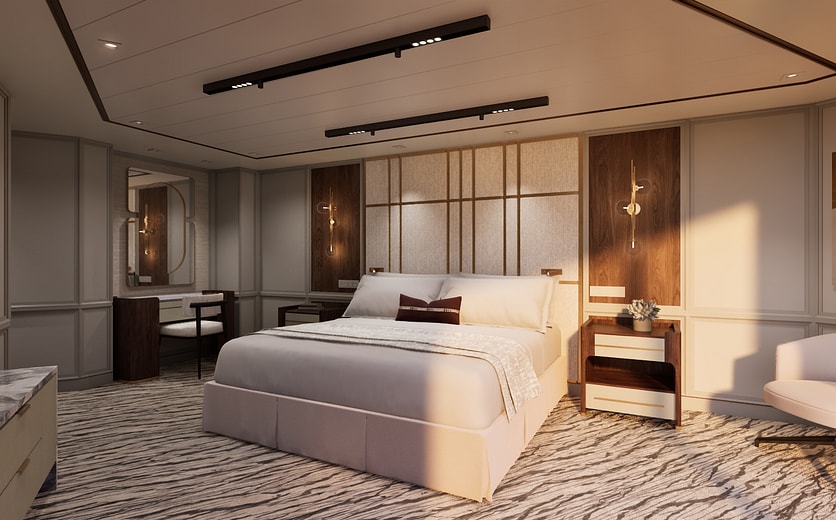
Ship renderings are artistic representations intended to provide a vision of the ship experience. Actual layouts, furnishings, and design elements may vary by deck, and specific location.
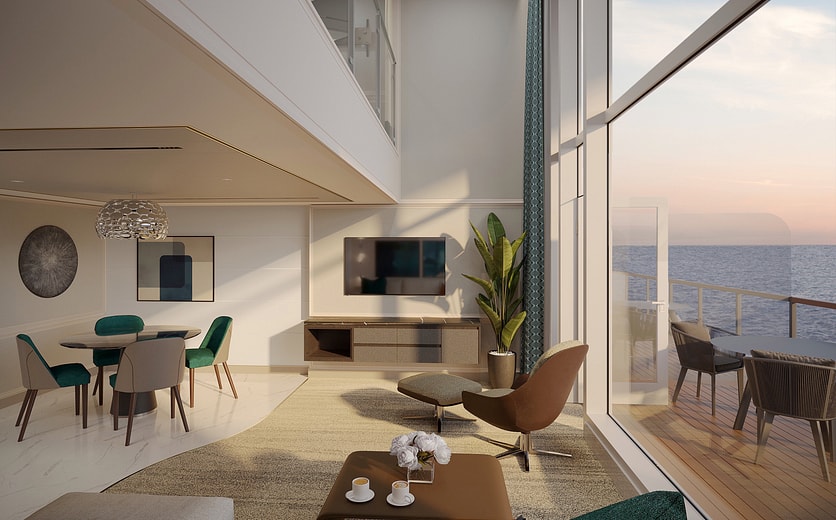
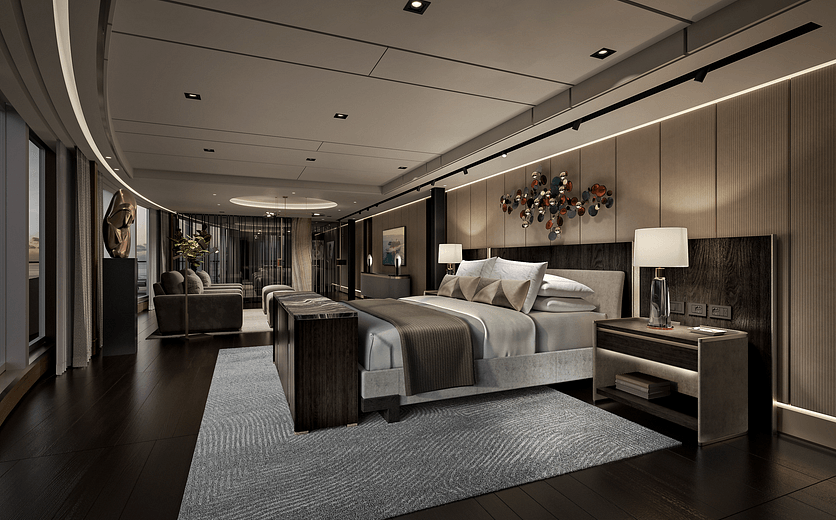
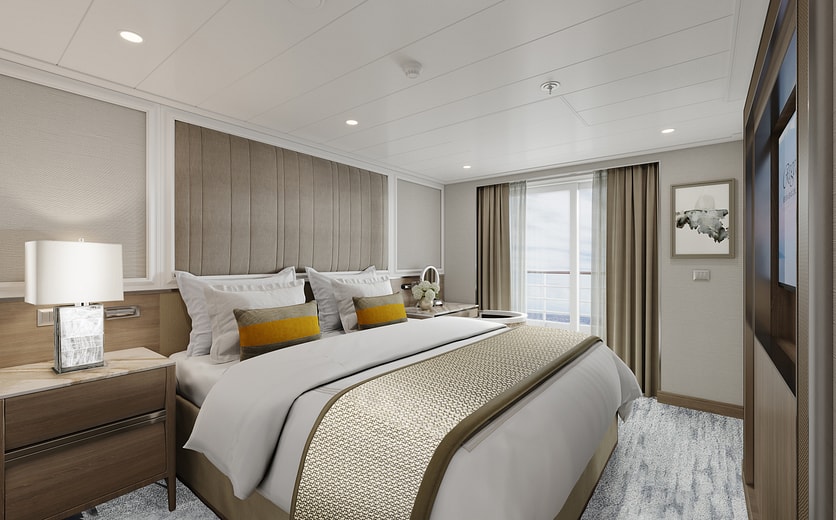
With their contemporary, sophisticated design, 4 double-story, 856 sq. ft. Grand Loft Suites evoke the feel of a refined Lower Manhattan residence. A dramatic double-height space and extraordinary window wall create jaw-dropping views from the upstairs loft bedroom, which faces directly toward the horizon. A neutral palette, tone-on-tone subtlety, and clean, tailored lines lend the suite a timeless yet modern character, with materials, fixtures, and fabrics carefully selected for their richness, comfort, and understated elegance.
Ship renderings are artistic representations intended to provide a vision of the ship experience. Actual layouts, furnishings, and design elements may vary by deck, and specific location.
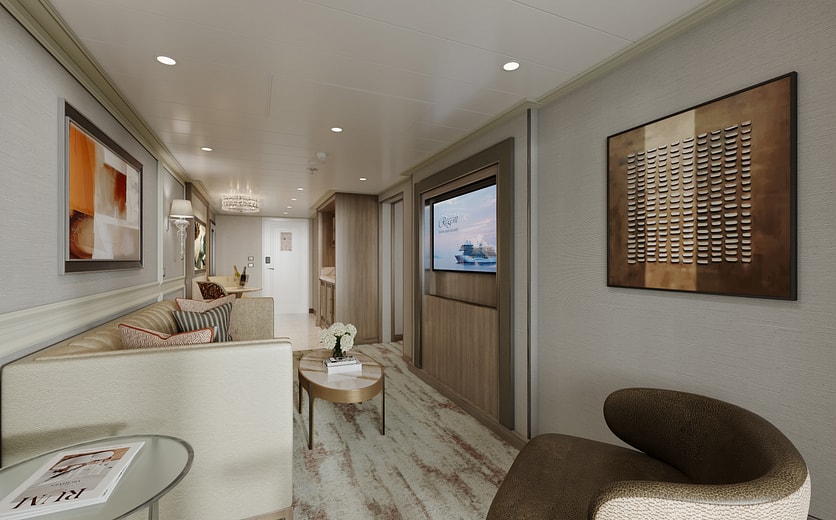
The Horizon Penthouse Suites on Seven Seas Prestige™ feature a beautifully appointed bedroom, a full bath suite, and a spacious living area. A standout feature in some of these suites is the oversized balcony—measuring up to 263 sq. ft.—which is part of the suite’s total size ranging from 600 sq. ft. to 726 sq. ft. This expansive outdoor space includes a dining area, plush sofa, and sun loungers, offering a perfect setting for open-air relaxation. With just 15 suites in this category, guests enjoy an exclusive experience that seamlessly blends indoor comfort with outdoor luxury.
Ship renderings are artistic representations intended to provide a vision of the ship experience. Actual layouts, furnishings, and design elements may vary by deck, and specific location.
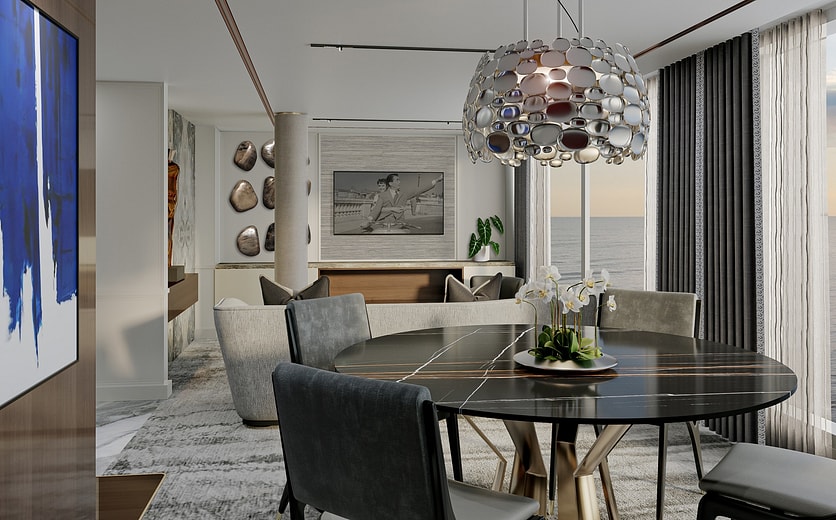
Offering a total of 2,037 sq. ft. the Signature Suites are outfitted with a rich color palette and the finest fabrics across two spacious bedrooms and two bathrooms, along with a generous living room. A private wraparound balcony — one of the largest at sea at 1,023 sq. ft. — extends the living space outdoors, making it ideal for entertaining or simply soaking in the view.
Ship renderings are artistic representations intended to provide a vision of the ship experience. Actual layouts, furnishings, and design elements may vary by deck, and specific location.
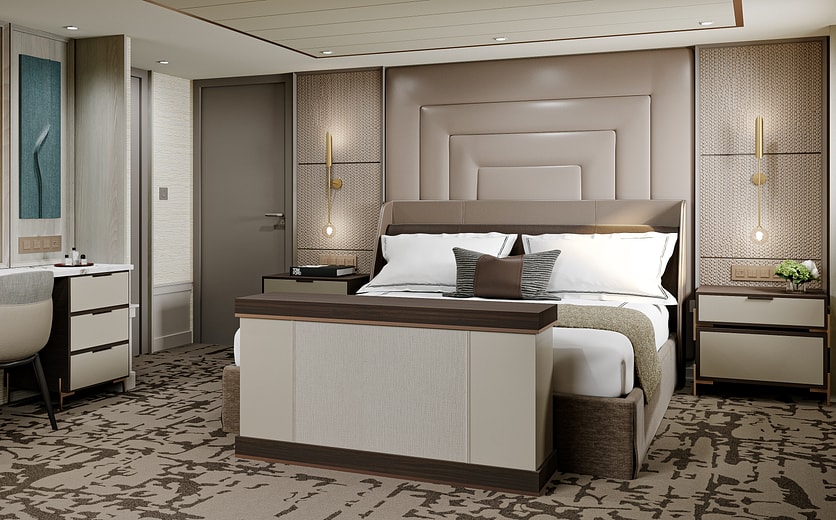
The Grand Suites feature clean lines, mid-century inspired furniture and a color palette that features neutrals with shades of green. The design highlights Italian artistry with textured fabrics and woven leather accents, creating a sophisticated and luxurious ambiance. At 1,214-1,417 sq. ft., the suite houses a private terrace as well as a dining room for in-suite meals.
Ship renderings are artistic representations intended to provide a vision of the ship experience. Actual layouts, furnishings, and design elements may vary by deck, and specific location.
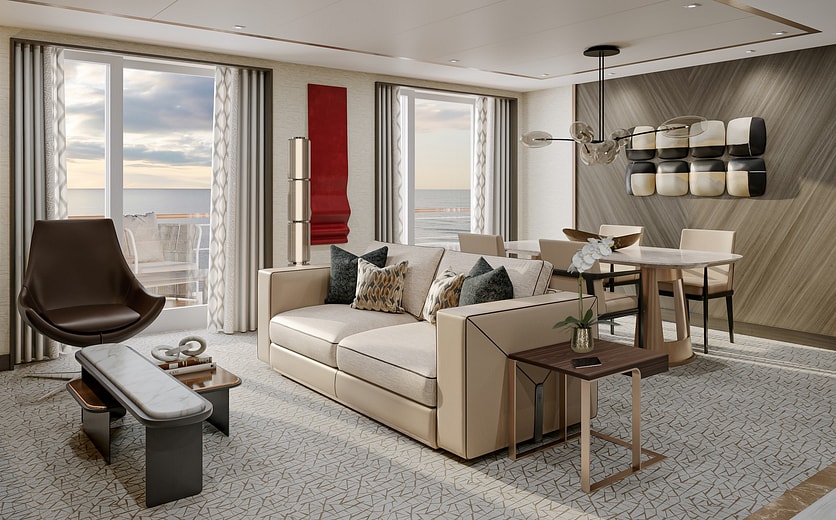
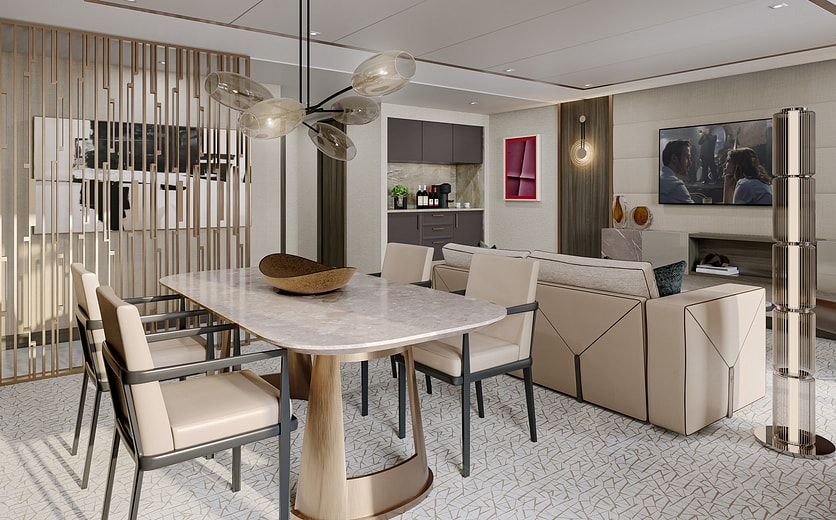
At 813-1,354 sq. ft., the thoughtfully designed Prestige Suites are the embodiment of refined living at sea. The one-bedroom, one-and-a-half bathroom suites are designed with calming hues of cream, gray and brown. They feature a dining table for in-suite service, a spacious closet and an elegant bath.
Ship renderings are artistic representations intended to provide a vision of the ship experience. Actual layouts, furnishings, and design elements may vary by deck, and specific location.
from £16,109 per person
Ship renderings are artistic representations intended to provide a vision of the ship experience. Actual layouts, furnishings, and design elements may vary by deck, and specific location.
With their contemporary, sophisticated design, 4 double-story, 856 sq. ft. Grand Loft Suites evoke the feel of a refined Lower Manhattan residence. A dramatic double-height space and extraordinary window wall create jaw-dropping views from the upstairs loft bedroom, which faces directly toward the horizon. A neutral palette, tone-on-tone subtlety, and clean, tailored lines lend the suite a timeless yet modern character, with materials, fixtures, and fabrics carefully selected for their richness, comfort, and understated elegance.
Ship renderings are artistic representations intended to provide a vision of the ship experience. Actual layouts, furnishings, and design elements may vary by deck, and specific location.
The Horizon Penthouse Suites on Seven Seas Prestige™ feature a beautifully appointed bedroom, a full bath suite, and a spacious living area. A standout feature in some of these suites is the oversized balcony—measuring up to 263 sq. ft.—which is part of the suite’s total size ranging from 600 sq. ft. to 726 sq. ft. This expansive outdoor space includes a dining area, plush sofa, and sun loungers, offering a perfect setting for open-air relaxation. With just 15 suites in this category, guests enjoy an exclusive experience that seamlessly blends indoor comfort with outdoor luxury.
Ship renderings are artistic representations intended to provide a vision of the ship experience. Actual layouts, furnishings, and design elements may vary by deck, and specific location.
Offering a total of 2,037 sq. ft. the Signature Suites are outfitted with a rich color palette and the finest fabrics across two spacious bedrooms and two bathrooms, along with a generous living room. A private wraparound balcony — one of the largest at sea at 1,023 sq. ft. — extends the living space outdoors, making it ideal for entertaining or simply soaking in the view.
Ship renderings are artistic representations intended to provide a vision of the ship experience. Actual layouts, furnishings, and design elements may vary by deck, and specific location.
The Grand Suites feature clean lines, mid-century inspired furniture and a color palette that features neutrals with shades of green. The design highlights Italian artistry with textured fabrics and woven leather accents, creating a sophisticated and luxurious ambiance. At 1,214-1,417 sq. ft., the suite houses a private terrace as well as a dining room for in-suite meals.
Ship renderings are artistic representations intended to provide a vision of the ship experience. Actual layouts, furnishings, and design elements may vary by deck, and specific location.
At 813-1,354 sq. ft., the thoughtfully designed Prestige Suites are the embodiment of refined living at sea. The one-bedroom, one-and-a-half bathroom suites are designed with calming hues of cream, gray and brown. They feature a dining table for in-suite service, a spacious closet and an elegant bath.
Ship renderings are artistic representations intended to provide a vision of the ship experience. Actual layouts, furnishings, and design elements may vary by deck, and specific location.





 0203 930 4640