Call
Call Enquire
 Search


Menu

Manage my booking

| Sales | |
| Monday - Friday | 09:00 - 20:00 |
| Saturday | 09:00 - 16:00 |
| Sunday | 10:00 - 17:00 |
| Bank Holiday | 10:00 - 16:00 |
| Aftersales | |
| Monday - Friday | 09:00 - 17:30 |
| Bank Holiday | 10:00 - 16:00 |



10 Dec - 17 Dec 2026

Return flights from the UK

7 Nights onboard AmaLucia

Bikes*

Overseas Transfers*

Full Board Drinks (with meals)*

Complimentary Dining*

Speciality Dining*

Shore Excursions*

Entertainment*
Not Available
Sold Out
Sold Out
Not Available
Our experts are here to help
Call us today on 0203 930 4640 or enquire online.





 Save up to £1500 per stateroom plus a complimentary upgrade and $100 onboard creditFly for Free to Europe in 2026 & 2027*2-for-1 Land Package Price on Select Mekong Sailings*
*Select voyages. T's and C's apply
Day 1
Amsterdam, the Netherlands. Arrive in Amsterdam and board your elegantly decorated river cruise ship. You’ll have free time before and after dinner to take a stroll through the city, perhaps to see the Christmas tree in Dam Square or watch locals ice skate in front of the Rijksmuseum. Catch a glimpse of the radiant installations of the Amsterdam Light Festival, set up annually along the city’s canals. (Meals: D)
Amsterdam combines the unrivaled beauty of the 17th-century Golden Age city center with plenty of museums and art of the highest order, not to mention a remarkably laid-back atmosphere. It all comes together to make this one of the world's most appealing and offbeat metropolises in the world. Built on a latticework of concentric canals like an aquatic rainbow, Amsterdam is known as the City of Canals—but it's no Venice, content to live on moonlight serenades and former glory. Quite the contrary: on nearly every street here you'll find old and new side by side—quiet corners where time seems to be holding its breath next to streets like neon-lit Kalverstraat, and Red Light ladies strutting by the city's oldest church. Indeed, Amsterdam has as many lovely facets as a 40-carat diamond polished by one of the city's gem cutters. It's certainly a metropolis, but a rather small and very accessible one. Locals tend to refer to it as a big village, albeit one that happens to pack the cultural wallop of a major world destination. There are scores of concerts every day, numerous museums, summertime festivals, and, of course, a legendary year-round party scene. It's pretty much impossible to resist Amsterdam's charms. With 7,000 registered monuments, most of which began as the residences and warehouses of humble merchants, set on 160 man-made canals, and traversed by 1,500 or so bridges, Amsterdam has the largest historical inner city in Europe. Its famous circle of waterways, the grachtengordel, was a 17th-century urban expansion plan for the rich and is a lasting testament to the city’s Golden Age. This town is endearing because of its kinder, gentler nature—but a reputation for championing sex, drugs, and rock ’n’ roll does not alone account for Amsterdam's being one of the most popular destinations in Europe: consider that within a single square mile the city harbors some of the greatest achievements in Western art, from Rembrandt to Van Gogh. Not to mention that this is one of Europe's great walking cities, with so many of its treasures in the untouted details: tiny alleyways barely visible on the map, hidden garden courtyards, shop windows, floating houseboats, hidden hofjes(courtyards with almshouses), sudden vistas of church spires, and gabled roofs that look like so many unframed paintings. And don’t forget that the joy lies in details: elaborate gables and witty gable stones denoting the trade of a previous owner. Keep in mind that those XXX symbols you see all over town are not a mark of the city's triple-X reputation. They're part of Amsterdam's official coat of arms—three St. Andrew's crosses, believed to represent the three dangers that have traditionally plagued the city: flood, fire, and pestilence. The coat's motto ("Valiant, determined, compassionate") was introduced in 1947 by Queen Wilhelmina in remembrance of the 1941 February Strike in Amsterdam—the first time in Europe that non-Jewish people protested against the persecution of Jews by the Nazi regime.
Day 2
Amsterdam/Utrecht. Step into centuries of history at Slot Zuylen, a castle first built around 1250 and shaped by generations that followed. A significant renovation in the mid-17th century transformed the castle. This, along with smaller changes over the centuries have created a rich tapestry of architectural styles, evident as you move through its rooms and corridors. Beyond the walls, the gardens offer a more peaceful, quieter retreat. Together, the castle and its gardens make Slot Zuylen a place where history feels layered, lived in, and very much alive.
Amsterdam combines the unrivaled beauty of the 17th-century Golden Age city center with plenty of museums and art of the highest order, not to mention a remarkably laid-back atmosphere. It all comes together to make this one of the world's most appealing and offbeat metropolises in the world. Built on a latticework of concentric canals like an aquatic rainbow, Amsterdam is known as the City of Canals—but it's no Venice, content to live on moonlight serenades and former glory. Quite the contrary: on nearly every street here you'll find old and new side by side—quiet corners where time seems to be holding its breath next to streets like neon-lit Kalverstraat, and Red Light ladies strutting by the city's oldest church. Indeed, Amsterdam has as many lovely facets as a 40-carat diamond polished by one of the city's gem cutters. It's certainly a metropolis, but a rather small and very accessible one. Locals tend to refer to it as a big village, albeit one that happens to pack the cultural wallop of a major world destination. There are scores of concerts every day, numerous museums, summertime festivals, and, of course, a legendary year-round party scene. It's pretty much impossible to resist Amsterdam's charms. With 7,000 registered monuments, most of which began as the residences and warehouses of humble merchants, set on 160 man-made canals, and traversed by 1,500 or so bridges, Amsterdam has the largest historical inner city in Europe. Its famous circle of waterways, the grachtengordel, was a 17th-century urban expansion plan for the rich and is a lasting testament to the city’s Golden Age. This town is endearing because of its kinder, gentler nature—but a reputation for championing sex, drugs, and rock ’n’ roll does not alone account for Amsterdam's being one of the most popular destinations in Europe: consider that within a single square mile the city harbors some of the greatest achievements in Western art, from Rembrandt to Van Gogh. Not to mention that this is one of Europe's great walking cities, with so many of its treasures in the untouted details: tiny alleyways barely visible on the map, hidden garden courtyards, shop windows, floating houseboats, hidden hofjes(courtyards with almshouses), sudden vistas of church spires, and gabled roofs that look like so many unframed paintings. And don’t forget that the joy lies in details: elaborate gables and witty gable stones denoting the trade of a previous owner. Keep in mind that those XXX symbols you see all over town are not a mark of the city's triple-X reputation. They're part of Amsterdam's official coat of arms—three St. Andrew's crosses, believed to represent the three dangers that have traditionally plagued the city: flood, fire, and pestilence. The coat's motto ("Valiant, determined, compassionate") was introduced in 1947 by Queen Wilhelmina in remembrance of the 1941 February Strike in Amsterdam—the first time in Europe that non-Jewish people protested against the persecution of Jews by the Nazi regime.
Day 2
Day 3
Düsseldorf or Cologne, Germany. Spend a relaxing morning cruising through scenic countryside to Düsseldorf. Stay in Düsseldorf for an afternoon bike ride or a walking tour of the historic center and its Christmas Market. Or head to Cologne, where the diverse architecture ranges from Romanesque churches to avant-garde buildings erected after the Allied bombings of World War II. Choose between a guided walk through the Old Town visiting the Fischmarkt and seeing Great St. Martin Church, or join an archaeological walking tour of its extensive Roman sites and the Belgian House where many Roman artifacts are on display. Venture into one of Europe’s largest and most renowned Christmas Markets, set against the soaring backdrop of the 13th-century Dom Cathedral, a UNESCO World Heritage Site. You’ll have free time to wander among the stalls, sipping a glühwein if you wish, or nibbling on lebkuchen (gingerbread). (Meals: B,L,D)
Day 4
Rhine Gorge and Rüdesheim. Enter the spectacular Upper Middle Rhine Valley, a UNESCO World Heritage Site also known as the Rhine Gorge. Here, more than 40 medieval castles perch on bluffs high over the river and charming villages dot the riverbanks, twinkling with holiday spirit at this time of year. Hear the legend of Lorelei Rock as you glide toward Rüdesheim, a gateway to the Rheingau wine region. Choose from a range of excursions: visit a wine cellar for a tasting of Rheingau wines, go on a hike or a guided bike ride, or ride a gondola over the vineyards, taking in stunning views. Then experience holiday traditions from around the world at the town’s Christmas Market. Later, see whimsical self-playing instruments at Siegfried’s Mechanical Instrument Cabinet, or taste one of the town’s specialties: Rüdesheimer coffee. (Meals: B,L,D)
Rudesheim am Rhine is a town in the Rhine Valley in Germany and part of the UNESCO World Heritage Site of Rhine Gorge. It is known for its production of Riesling wine and has been popular for its wine making since ancient times. The Medieval Bromserburg Castle is home to the Rheingau Wine Museum and wine is a crucial part of Rudesheimer culture. The town is surrounded with vineyards and wineries, as well as many local wine bars and seasonal wine taverns. Wine tasting is a must do in Rudesheim and dining out is a great accompaniment. The local cuisine is seasonal and is closely intertwined with the wine growing traditions together with soups such as Zwiebelkuchen, Handkäs mit Musik and Spundekäs. Nordic Walking is popular around town, with five adventure trails around the vicinity, as well as many popular cycling routes. Great views of the town can be found from the water, the cable car to Niederwald Monument and the Monument itself. Old Town has the best examples of the town’s architecture with Eagle Tower, Oberstrasse and Rheinstein Castle some key sites to visit.
Day 5
Heidelberg or Speyer. From the riverside town of Ludwigshafen, explore your choice of historic Rhineland cities and their festive Christmas Markets. Visit Heidelberg, a city that will capture your heart with its mighty castle and centuries-old university. Here, wander along one of Europe’s longest pedestrian shopping streets, the Hauptstrasse, soaking up the yuletide celebrations at the town’s Christmas Market. Or hike along the historic Philosopher’s Path, enjoying views of Heidelberg’s castle and the city below, then enjoy free time to browse the Christmas Markets. Alternatively, bike along the River Neckar to medieval Ladenburg and visit its Marktplatz, or explore one of Germany’s oldest cities, Speyer, known for the largest Romanesque cathedral in Europe, a UNESCO World Heritage Site; and tour the Technik Museum to see a fascinating collection that includes vintage cars, a submarine and a space shuttle. You’ll have time to visit its Christmas Market in front of the Old Mint (Alten Münze). (Meals: B,L,D)
Day 6
Strasbourg, France. Strasbourg becomes even more enchanting during the season of Advent. Its Christkindelsmärik, dating back to 1570, is the oldest Christmas Market in France and one of the largest. Walk through the historic town center on the Grande Île, a UNESCO World Heritage Site, and through the lovely Petite France district, where timeless, half-timbered houses line winding canals. See the Cathédrale de Nôtre Dame and its famous astronomical clock and then delve into the town’s famous Christmas Market, perhaps sampling a vin chaud or one of the city’s famous Christmas cookies. Alternatively, opt to visit the seat of the European Parliament on a guided tour (subject to availability). You may also choose to explore Strasbourg’s different neighborhoods on a guided bike tour. Later this afternoon, opt to visit the historic spa town of Baden-Baden and its romantic Christmas Markets. (Meals: B,L,D)
Day 7
Colmar or Breisach, Germany. Go ashore in the German town of Breisach, poised on the border between the Alsace region of France and Germany’s Black Forest. In the fairytale Alsatian town of Colmar, experience a whimsical blend of French and German culture, and choose to tour the home of August Bartholdi, the sculptor of the Statue of Liberty, or explore the town’s wonderful Christmas Markets. Alternatively, venture to the UNESCO-designated Neuf-Brisach Citadel, or ride a bicycle through the countryside around Breisach. (Meals: B,L,D)
Breisach is a town located in Southwest Germany on the French border. The town is situated in the Rhine Valley on the banks of the river Rhine and dates back over four thousand years. Breisach and its history can be experienced through the City History Museum, which houses a permanent exhibition taking you from Stone Age through the Celtic, to the Romans and Middle Ages, right up to modern day. St Stephen's Cathedral is home to the city’s famous art treasures, the wheel wells, which are housed in the neighbouring Radbrunnenturm with the forty one metre deep water well. The cathedral is also home to many other treasures including the High Altar of Master HL and wall paintings by Martin Schongauer as well as High Gothic and Roman architecture. A visit to the Blue House, the former Jewish Community Centre, is highly recommended. Now owned by the Friends of Former Jewish Community House Breisach it exhibits memorials to Breisach’s Jewish heritage.
Day 8
Basel. Disembark the ship and bid farewell to Basel as you prepare for your return flight home. (B)
Basel is a city in northwestern Switzerland on the Swiss, French and German borders. It is located on the bend of the River Rhine and benefits from a Mediterranean climate. It is the third most populated city in Switzerland and has been the commercial hub for Swiss arts and culture since the Renaissance. In 1967 the people of Basel voted to acquire two paintings by Picasso, who was so moved by the Basel people that he donated 3 paintings and a study to the city's Kunstmuseum (Museum of Fine Arts). Visit the Augusta Raurica, one of the largest Roman archaeology parks in Switzerland, and enjoy a river crossings over the River Rhine by non-motorised ferries. During the summer months, time is spent outdoors, either swimming in the River Rhine, dining al fresco, enjoying open air concerts, cinema, street parties and festivals. Basel is home to over 20 restaurants that have won GaultMillau or Michelin awards, and boasts Switzerland's largest collection of theatre shows, including modern contemporary dance, touring and puppetry theatre.

from £0 per person
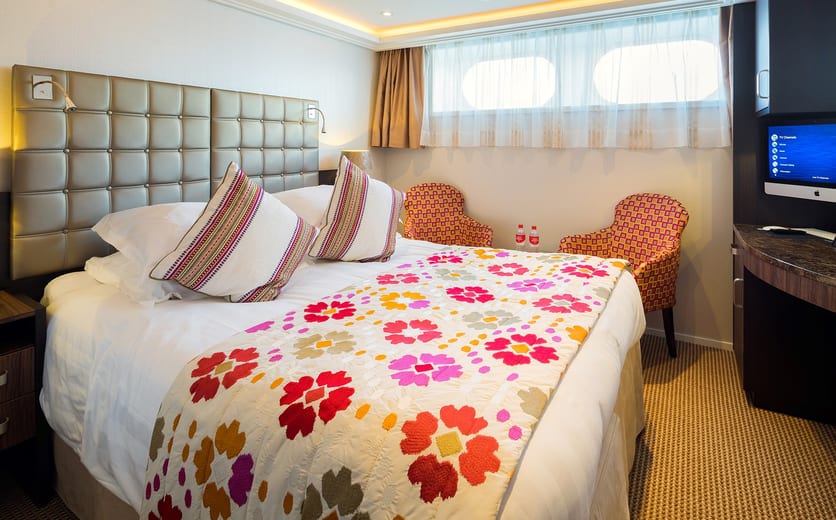
Stateroom Features
from £0 per person
from £0 per person
Stateroom Features
from £0 per person





 0203 930 4640