Call
 Enquire
 Search



Menu

Manage my booking

| Sales | |
| Monday - Friday | 09:00 - 19:00 |
| Saturday | 09:00 - 16:00 |
| Sunday | 10:00 - 17:00 |
| Bank Holiday | 10:00 - 16:00 |
| Aftersales | |
| Monday - Friday | 09:00 - 17:30 |
| Bank Holiday | 10:00 - 16:00 |



10 Feb - 25 Mar 2029

43 Nights onboard Queen Elizabeth

Inclusion package upgrades available on request*

Kids Club*

Room Service*

Complimentary Dining*

Entertainment*
from
£6,499
per person
from
£7,799
per person
from
£9,499
per person
from
£19,999
per person
Our experts are here to help
Call us today on 0203 930 4640 or enquire online.




 Save 10% on new 2028 &2029 Voyages*Low Deposits from £50pp*Cunard Signature Packages*
*Select voyages. T's and C's apply
Day 1
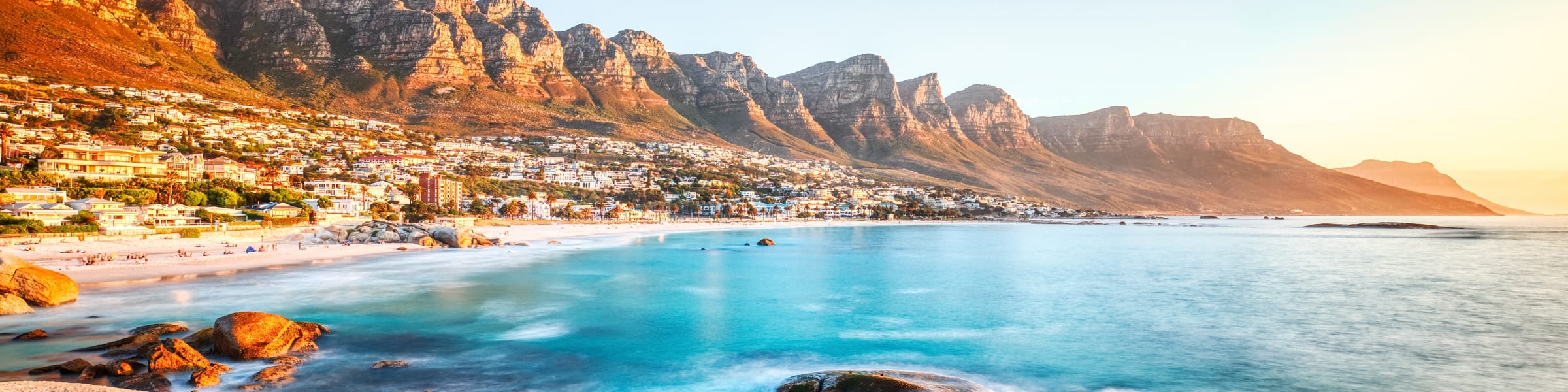
Sometimes referred to as the Mother City, Cape Town is the most famous port in South Africa and is influenced by many different cultures, including Dutch, British and Malay. The port was founded in 1652 by Dutch explorer Jan Van Riebeeck, and evidence of Dutch colonial rule remains throughout the region. The port is located on one of the world's most important trade routes, and is mainly a container port and handler of fresh fruit. Fishing is another vital industry, with large Asian fishing fleets using Cape Town as a logistical repair base for much of the year. The region is famous for its natural beauty, with the imposing Table Mountain and Lions Head, as well as the many nature reserves and botanical gardens such as Kirstenbosch which boasts an extensive range of indigenous plant life, including proteas and ferns. Cape Town's weather is mercurial, and can change from beautiful sunshine to dramatic thunderstorms within a short period. A local adage is that in Cape Town you can experience four seasons in one day.
Day 2
Day 3
Originally the home of the San and Khoisan people and later the Xhosa tribe, the area now known as Gqeberha (previously Port Elizabeth) became a landing place for passing European ships after Portuguese navigator Bartolomew Diaz arrived in Algoa Bay in 1488. As part of the Cape Colony, the British occupied the area during the Napoleonic Wars and it was they who built Fort Frederick here in 1799. Twenty-one years later 4,000 settlers arrived, becoming the first permanent British residents of South Africa and Gqeberha. Sir Rufane Donkin, Acting Governor of the Cape Colony, founded Port Elizabeth, naming the settlement after his late wife. The town underwent rapid growth after 1873 following the construction of the railway to Kimberley, and is now one of the country’s major seaports. Like most South African cities, miles of beautiful coastline surround Gqeberha. Algoa Bay combines warm water and fair breezes, making it a mecca for swimmers and water sports enthusiasts. Those interested in history can follow the Donkin Heritage Trail, past a succession of Victorian and Edwardian town houses, trim gardens and neo-Gothic churches. Just outside the town are a number of game reserves, including the famous Addo Elephant National Park.
Day 4
Day 5
Durban, a glistening jewel on the south-east coast of Africa, is the third largest city in South Africa and the major city of KwaZulu-Natal. It has been a centre of sea trade since before colonisation and now has a flourishing artistic centre, which perfectly complements the vibrant markets and rich cultures of the city. Durban’s port is a natural half-moon harbour lined with white sand and azure water, punctuated by the port’s many piers which reach into the water like the leaves of a fan. The beaches of Durban’s famous Golden Mile stretch along the harbour and are popular all year round, as travellers and locals alike enjoy Durban’s warm, humid summers and mild, dry winters.
Day 6
Day 7
Day 8
Day 9
Pointe des Galets, located on the western coast of Réunion Island, is a charming coastal destination that blends natural beauty with local culture. Known for its scenic beaches lined with unique volcanic pebbles, the area offers stunning ocean views and relaxing seaside walks. Visitors can enjoy water-based activities such as swimming, snorkeling, and fishing, while the surrounding landscapes are perfect for photography and nature exploration. The nearby port and bustling market provide a taste of local life, offering fresh seafood, tropical fruits, and handcrafted souvenirs. With its mix of tranquility and vibrant culture, Pointe des Galets is ideal for travelers seeking a serene escape while experiencing the authentic charm of Réunion Island’s coastal communities. Its sunsets over the Indian Ocean are especially unforgettable.
Day 10
Mauritius, a jewel of the Indian Ocean, is a paradise for travelers seeking sun, sea, and culture. Famous for its pristine white-sand beaches, turquoise lagoons, and vibrant coral reefs, the island offers world-class snorkeling, diving, and water sports. Beyond its natural beauty, Mauritius boasts lush sugarcane fields, volcanic landscapes, and the scenic Black River Gorges National Park, perfect for hiking and wildlife spotting. Its rich cultural tapestry reflects African, Indian, European, and Chinese influences, evident in colorful festivals, bustling markets, and diverse cuisine. Charming colonial architecture, luxury resorts, and warm, welcoming locals enhance the visitor experience. Whether relaxing on a serene beach, exploring scenic trails, or savoring local delicacies, Mauritius promises an unforgettable blend of adventure, culture, and tranquility, making it a must-visit destination.
Day 11
Day 12
Day 13
Day 14
Day 15
Day 16
Day 17
Day 18
Kuala Lumpur, or KL as locals refer to it, intrigues visitors with its diversity and multicultural character. The city's old quarter features stretches of shop houses that hint at its colonial past, while modern buildings—including the iconic Petronas Towers—give a glimpse of its modern financial ambitions. The city is filled with culturally colorful quarters dedicated to Chinese, Malay, and Indian communities. New shopping malls with designer labels, five-star hotels, and top-notch restaurants also proliferate in this bustling city of 1.6 million.
Day 19
The main island of Singapore is shaped like a flattened diamond, 42 km (26 miles) east to west and 23 km (14 miles) north to south. Near the northern peak is the causeway leading to West Malaysia—Kuala Lumpur is less than four hours away by car. It is at the southern foot where you will find most of the city-state’s action, with its gleaming office towers, working docks, and futuristic "supertrees," which are solar-powered and serve as vertical gardens. Offshore are Sentosa and over 60 smaller islands, most uninhabited, that serve as bases for oil refining or as playgrounds and beach escapes from the city. To the east is Changi International Airport, connected to the city by metro, bus, and a tree-lined parkway. Of the island's total land area, more than half is built up, with the balance made up of parkland, farmland, plantations, swamp areas, and rain forest. Well-paved roads connect all parts of the island, and Singapore city has an excellent, and constantly expanding, public transportation system. The heart of Singapore's history and its modern wealth are in and around the Central Business District. The area includes the skyscrapers in the Central Business District, the 19th-century Raffles Hotel, the convention centers of Marina Square, on up to the top of Ft. Canning. Although most of old Singapore has been knocked down to make way for the modern city, most colonial landmarks have been preserved in the CBD, including early-19th-century buildings designed by the Irish architect George Coleman.
Day 20
The main island of Singapore is shaped like a flattened diamond, 42 km (26 miles) east to west and 23 km (14 miles) north to south. Near the northern peak is the causeway leading to West Malaysia—Kuala Lumpur is less than four hours away by car. It is at the southern foot where you will find most of the city-state’s action, with its gleaming office towers, working docks, and futuristic "supertrees," which are solar-powered and serve as vertical gardens. Offshore are Sentosa and over 60 smaller islands, most uninhabited, that serve as bases for oil refining or as playgrounds and beach escapes from the city. To the east is Changi International Airport, connected to the city by metro, bus, and a tree-lined parkway. Of the island's total land area, more than half is built up, with the balance made up of parkland, farmland, plantations, swamp areas, and rain forest. Well-paved roads connect all parts of the island, and Singapore city has an excellent, and constantly expanding, public transportation system. The heart of Singapore's history and its modern wealth are in and around the Central Business District. The area includes the skyscrapers in the Central Business District, the 19th-century Raffles Hotel, the convention centers of Marina Square, on up to the top of Ft. Canning. Although most of old Singapore has been knocked down to make way for the modern city, most colonial landmarks have been preserved in the CBD, including early-19th-century buildings designed by the Irish architect George Coleman.
Day 21
Day 22
Day 23
Day 24
The Hong Kong Island skyline, with its ever-growing number of skyscrapers, speaks to ambition and money. Paris, London, even New York were centuries in the making, while Hong Kong's towers, bright lights, and glitzy shopping emporia weren't yet part of the urban scene when many of the young investment bankers who fuel one of the world's leading financial centers were born. Commerce is concentrated in the glittering high-rises of Central, tucked between Victoria Harbor and forested peaks on Hong Kong Island's north shore. While it's easy to think all the bright lights are the sum of today's Hong Kong, you need only walk or board a tram for the short jaunt west into Western to discover a side of Hong Kong that is more traditionally Chinese but no less high-energy. You'll discover the real Hong Kong to the east of Central, too, in Wan Chai, Causeway Bay, and beyond. Amid the residential towers are restaurants, shopping malls, bars, convention centers, a nice smattering of museums, and—depending on fate and the horse you wager on—one of Hong Kong's luckiest or unluckiest spots, the Happy Valley Racecourse. Kowloon sprawls across a generous swath of the Chinese mainland across Victoria Harbour from Central. Tsim Sha Tsui, at the tip of Kowloon peninsula, is packed with glitzy shops, first-rate museums, and eye-popping views of the skyline across the water. Just to the north are the teeming market streets of Mong Kok and in the dense residential neighborhoods beyond, two of Hong Kong's most enchanting spiritual sights, Wong Tai Sin Temple and Chi Lin Nunnery. As you navigate this huge metropolis (easy to do on the excellent transportation network), keep in mind that streets are usually numbered odd on one side, even on the other. There's no baseline for street numbers and no block-based numbering system, but street signs indicate building numbers for any given block.
Day 25
The Hong Kong Island skyline, with its ever-growing number of skyscrapers, speaks to ambition and money. Paris, London, even New York were centuries in the making, while Hong Kong's towers, bright lights, and glitzy shopping emporia weren't yet part of the urban scene when many of the young investment bankers who fuel one of the world's leading financial centers were born. Commerce is concentrated in the glittering high-rises of Central, tucked between Victoria Harbor and forested peaks on Hong Kong Island's north shore. While it's easy to think all the bright lights are the sum of today's Hong Kong, you need only walk or board a tram for the short jaunt west into Western to discover a side of Hong Kong that is more traditionally Chinese but no less high-energy. You'll discover the real Hong Kong to the east of Central, too, in Wan Chai, Causeway Bay, and beyond. Amid the residential towers are restaurants, shopping malls, bars, convention centers, a nice smattering of museums, and—depending on fate and the horse you wager on—one of Hong Kong's luckiest or unluckiest spots, the Happy Valley Racecourse. Kowloon sprawls across a generous swath of the Chinese mainland across Victoria Harbour from Central. Tsim Sha Tsui, at the tip of Kowloon peninsula, is packed with glitzy shops, first-rate museums, and eye-popping views of the skyline across the water. Just to the north are the teeming market streets of Mong Kok and in the dense residential neighborhoods beyond, two of Hong Kong's most enchanting spiritual sights, Wong Tai Sin Temple and Chi Lin Nunnery. As you navigate this huge metropolis (easy to do on the excellent transportation network), keep in mind that streets are usually numbered odd on one side, even on the other. There's no baseline for street numbers and no block-based numbering system, but street signs indicate building numbers for any given block.
Day 26
Day 27
MANILA, the capital city of the Philippines, was founded in, 1571 by Spanish conquistador Miguel López de Legazpi. It is one of the oldest cities in the country and was the seat of power for most of the colonial rules of the Philippines. It is situated on the eastern shore of Manila Bay and contains a multitude of landmarks, some of which date back to the 16th century. It is home to the baroque 16th-century San Agustin Church as well as Fort Santiago, a storied citadel and military prison. In the 19th century Manila became one of the most modern cities in Asia. Before the Spanish–American War, Manila saw the rise of the Philippine Revolution. Under the American rule following the Spanish-American War, the United States changed the official language from Spanish to English. Towards the end of World War II, during the Battle of Manila, most of the city was flattened by intensive aerial bombardment. Today, tourism is a vital industry in Manila. Major shopping malls and bazaars thrive around Manila.
Day 28
Day 29
Day 30
Day 31
Bali really is as alluring as everyone says. This island, slightly bigger than Delaware, has it all: beaches, volcanoes, terraced rice fields, forests, renowned resorts, surfing, golf, and world-class dive sites. But what sets Bali apart from other nearby tropical destinations is Balinese tradition, and villagers dedicated to celebrating it. The hundreds of temples, dances, rituals, and crafts linked to their ancient Hindu faith aren't a show for tourists, but a living, breathing culture in which visitors are warmly received by the Balinese, who cherish their own identities.
Day 32
Day 33
Day 34
Day 35
The port city of Fremantle is a jewel in Western Australia's crown, largely because of its colonial architectural heritage and hippy vibe. Freo (as the locals call it) is a city of largely friendly, interesting, and sometimes eccentric residents supportive of busking, street art, and alfresco dining. Like all great port cities, Freo is cosmopolitan, with mariners from all parts of the world strolling the streets—including thousands of U.S. Navy personnel on rest and recreation throughout the year. It's also a good jumping-off point for a day trip to Rottnest Island, where lovely beaches, rocky coves, and unique wallaby-like inhabitants called quokkas set the scene.Modern Fremantle is a far cry from the barren, sandy plain that greeted the first wave of English settlers back in 1829 at the newly constituted Swan River Colony. Most were city dwellers, and after five months at sea in sailing ships they landed on salt-marsh flats that sorely tested their fortitude. Living in tents with packing cases for chairs, they found no edible crops, and the nearest freshwater was a distant 51 km (32 miles)—and a tortuous trip up the waters of the Swan. As a result they soon moved the settlement upriver to the vicinity of present-day Perth.Fremantle remained the principal port, and many attractive limestone buildings were built to service the port traders. Australia's 1987 defense of the America's Cup—held in waters off Fremantle—triggered a major restoration of the colonial streetscapes. In the leafy suburbs nearly every other house is a restored 19th-century gem.
Day 36
Day 37
Day 38
Day 39
Kangaroo Island is with 1,740 square miles the third largest island off the coast of Australia. It is 96 miles long and 34 miles wide, and known for its outstanding natural beauty. Due to its remote location, Kangaroo Island was less affected than the mainland by the impact of European development. To this day, the island is rich in diverse flora and fauna seldom found elsewhere. As one of the world’s last unspoiled wilderness places, about 30 percent of the island has been designated as National Parks. The most important one is Flinders Chase at the western end of Kangaroo Island, with Seal Bay Conservation Park following close behind. Its large sandy beach and dune area is home to Australian sea lions where they come to rest and nurse their young. Kingscote, formerly known as Queenscliffe, is the largest town on the island and its main supply depot. Tourism is a significant element in the local economy. A mix of attractive small townships, wildlife sanctuaries and fascinating wilderness areas guarantee a steady stream of visitors each year.
Day 40
Day 41
Consistently rated among the "world's most livable cities" in quality-of-life surveys, Melbourne is built on a coastal plain at the top of the giant horseshoe of Port Phillip Bay. The city center is an orderly grid of streets where the state parliament, banks, multinational corporations, and splendid Victorian buildings that sprang up in the wake of the gold rush now stand. This is Melbourne's heart, which you can explore at a leisurely pace in a couple of days.In Southbank, one of the newer precincts south of the city center, the Southgate development of bars, restaurants, and shops has refocused Melbourne's vision on the Yarra River. Once a blighted stretch of factories and run-down warehouses, the southern bank of the river is now a vibrant, exciting part of the city, and the river itself is finally taking its rightful place in Melbourne's psyche.Just a hop away, Federation Square—with its host of galleries—has become a civic landmark for Melburnians. Stroll along the Esplanade in the suburb of St. Kilda, amble past the elegant houses of East Melbourne, enjoy the shops and cafés in Fitzroy or Carlton, rub shoulders with locals at the Victoria Market, nip into the Windsor for afternoon tea, or rent a canoe at Studley Park to paddle along one of the prettiest stretches of the Yarra—and you may discover Melbourne's soul as well as its heart.
Day 42
Burnie overlooks Emu Bay, on the north-west coast. This proudly industrial city is Australia’s fifth largest container port and a vibrant place to visit. Burnie was once surrounded by dense rainforest, but this has slowly disappeared, while fortunes were made felling and milling timber. The paper and pulp mill on the city’s outskirts operated from 1938 to 1998. Burnie was first explored by Bass and Flinders and was known as Emu Bay when it was settled by the Van Diemen’s Land Company in 1827. Today, Burnie has a population of almost 19,000. Burnie experiences temperate conditions, with an average maximum of 70 degrees Fahrenheit (21 degrees Celsius) in January and 56.5 degrees Fahrenheit (13.5) degrees Celsius in June.
Day 43
Day 44
Sydney, capital of New South Wales and one of Australia's largest cities, is best known for its harbourfront Sydney Opera House, with a distinctive sail-like design. Massive Darling Harbour and the smaller Circular Quay port are hubs of waterside life, with the arched Harbour Bridge and esteemed Royal Botanic Garden nearby. Sydney Tower’s outdoor platform, the Skywalk, offers 360-degree views of the city and suburbs.

from £6,499 per person
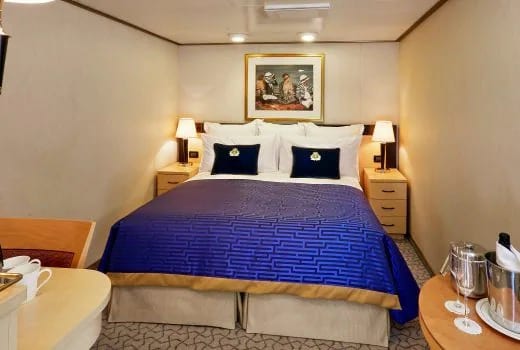
Approximately 152 sq. ft.
With a variety of locations to choose from on board, our well-appointed Britannia Standard Inside staterooms are a haven of comfort and style to enjoy during your voyage. You’ll find thoughtful features and luxurious amenities, all organised by your dedicated steward to ensure you are always attentively looked after.
Each Britannia Standard Inside stateroom includes:
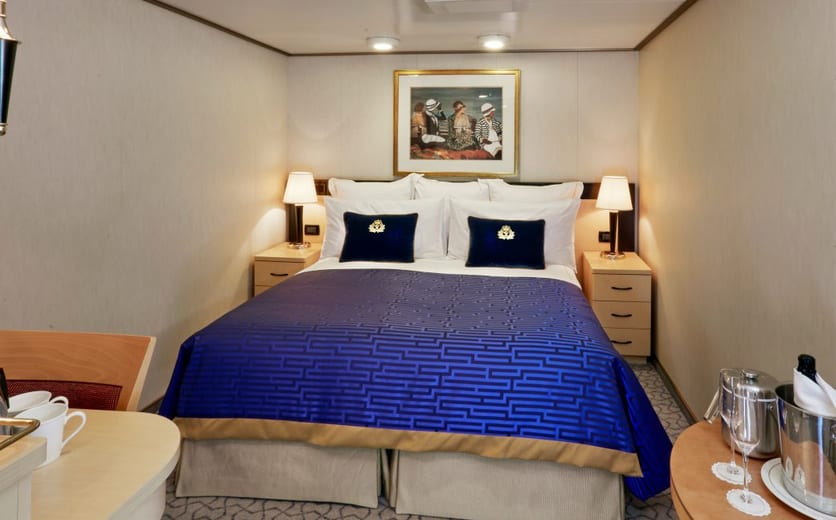
Approximately 157-194 sq. ft.
With a variety of locations to choose from on board, our well-appointed inside staterooms are a haven of comfort and style to enjoy during your voyage. You’ll find thoughtful features and luxurious amenities, all organised by your dedicated steward to ensure you are always attentively looked after.
Each Britannia Standard Inside stateroom includes:
Choice of Early, Late, and Open Dining in the Britannia Restaurant.
Cunarder bed configurable to king-size or two single beds.
Bathroom with a walk-in shower.
Satellite TV with movie and music channels.
Feature vanity and desk with hairdryer.
UK, USA, and European power sockets.
Penhaligon's toiletries.
Bathrobes and slippers.
Tea and coffee making facilities.
Welcome sparkling wine.
Complimentary room service menu.
Mini-bar packages available for purchase.
A dedicated steward to keep your stateroom in fine order day and night.
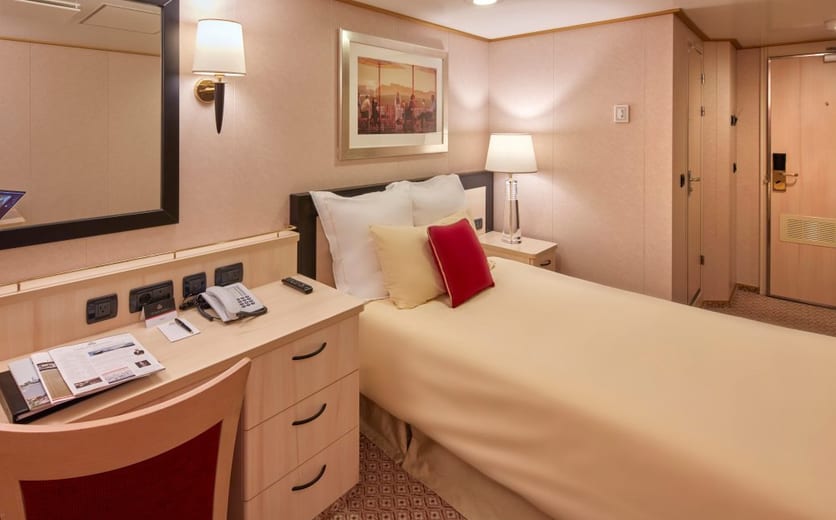
Approximately 159 sq. ft.
Our spacious Britannia Single Inside staterooms are a haven of comfort and style to enjoy during your voyage. You’ll find thoughtful features and luxurious amenities, all organised by your dedicated steward to ensure you are always attentively looked after.
Each Britannia Single Inside stateroom includes:
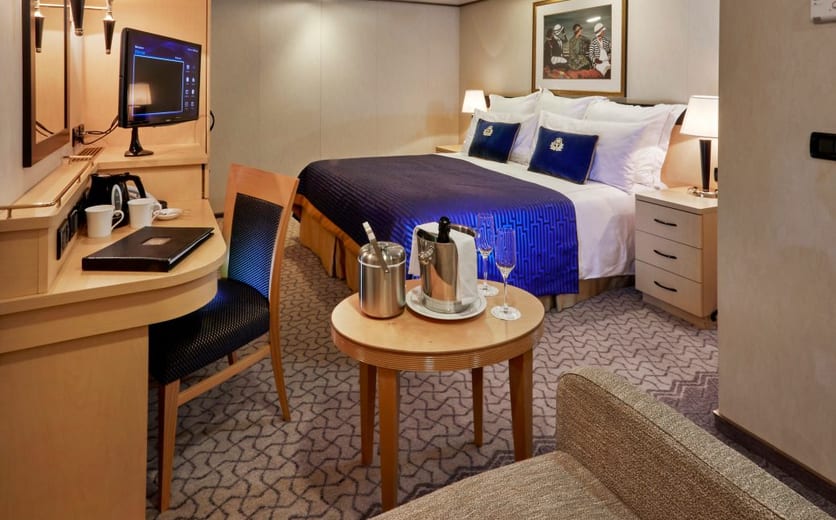
Approximately 200 sq. ft.
With a variety of locations to choose from on board, our spacious Britannia Deluxe Inside staterooms are a haven of comfort and style to enjoy during your voyage. You’ll find thoughtful features and luxurious amenities, all organised by your dedicated steward to ensure you are always attentively looked after.
Each Britannia Deluxe Inside stateroom includes:
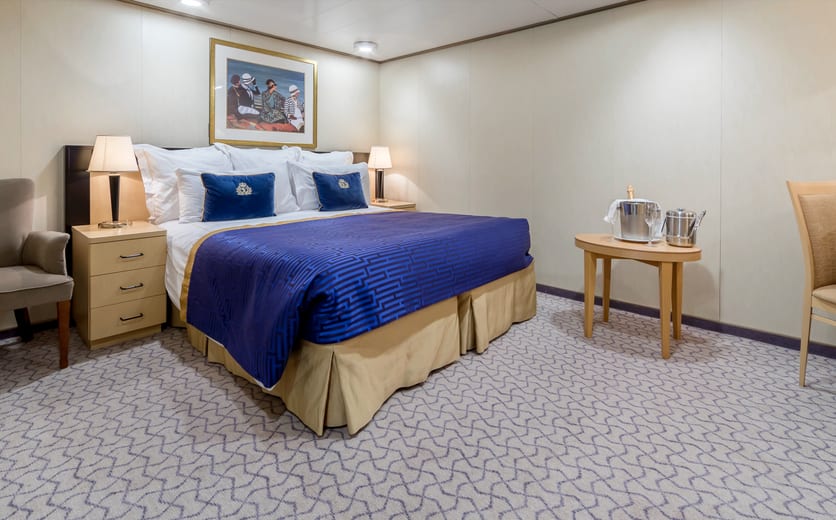
With a variety of locations to choose from on board our spacious Britannia Deluxe Inside staterooms are a haven of comfort and style to enjoy during your voyage. You’ll find thoughtful features and luxurious amenities all organised by your dedicated steward to ensure you are always attentively looked after.
Each Britannia Deluxe Inside stateroom includes:

With a variety of locations to choose from on board our well-appointed Britannia Standard Inside staterooms are a haven of comfort and style to enjoy during your voyage. You’ll find thoughtful features and luxurious amenities all organised by your dedicated steward to ensure you are always attentively looked after.
Each Britannia Standard Inside stateroom includes:
Our spacious Britannia Single Inside staterooms are a haven of comfort and style to enjoy during your voyage. You’ll find thoughtful features and luxurious amenities all organised by your dedicated steward to ensure you are always attentively looked after.
Each Britannia Single Inside stateroom includes:
from £7,799 per person
from £9,499 per person
from £19,999 per person
from £6,499 per person
Approximately 152 sq. ft.
With a variety of locations to choose from on board, our well-appointed Britannia Standard Inside staterooms are a haven of comfort and style to enjoy during your voyage. You’ll find thoughtful features and luxurious amenities, all organised by your dedicated steward to ensure you are always attentively looked after.
Each Britannia Standard Inside stateroom includes:
Approximately 157-194 sq. ft.
With a variety of locations to choose from on board, our well-appointed inside staterooms are a haven of comfort and style to enjoy during your voyage. You’ll find thoughtful features and luxurious amenities, all organised by your dedicated steward to ensure you are always attentively looked after.
Each Britannia Standard Inside stateroom includes:
Choice of Early, Late, and Open Dining in the Britannia Restaurant.
Cunarder bed configurable to king-size or two single beds.
Bathroom with a walk-in shower.
Satellite TV with movie and music channels.
Feature vanity and desk with hairdryer.
UK, USA, and European power sockets.
Penhaligon's toiletries.
Bathrobes and slippers.
Tea and coffee making facilities.
Welcome sparkling wine.
Complimentary room service menu.
Mini-bar packages available for purchase.
A dedicated steward to keep your stateroom in fine order day and night.
Approximately 159 sq. ft.
Our spacious Britannia Single Inside staterooms are a haven of comfort and style to enjoy during your voyage. You’ll find thoughtful features and luxurious amenities, all organised by your dedicated steward to ensure you are always attentively looked after.
Each Britannia Single Inside stateroom includes:
Approximately 200 sq. ft.
With a variety of locations to choose from on board, our spacious Britannia Deluxe Inside staterooms are a haven of comfort and style to enjoy during your voyage. You’ll find thoughtful features and luxurious amenities, all organised by your dedicated steward to ensure you are always attentively looked after.
Each Britannia Deluxe Inside stateroom includes:
With a variety of locations to choose from on board our spacious Britannia Deluxe Inside staterooms are a haven of comfort and style to enjoy during your voyage. You’ll find thoughtful features and luxurious amenities all organised by your dedicated steward to ensure you are always attentively looked after.
Each Britannia Deluxe Inside stateroom includes:
With a variety of locations to choose from on board our well-appointed Britannia Standard Inside staterooms are a haven of comfort and style to enjoy during your voyage. You’ll find thoughtful features and luxurious amenities all organised by your dedicated steward to ensure you are always attentively looked after.
Each Britannia Standard Inside stateroom includes:
Our spacious Britannia Single Inside staterooms are a haven of comfort and style to enjoy during your voyage. You’ll find thoughtful features and luxurious amenities all organised by your dedicated steward to ensure you are always attentively looked after.
Each Britannia Single Inside stateroom includes:
from £7,799 per person
from £9,499 per person
from £19,999 per person





 0203 930 4640